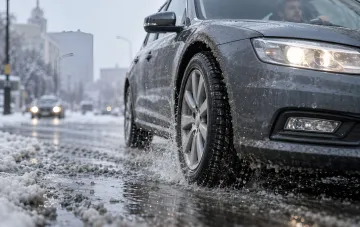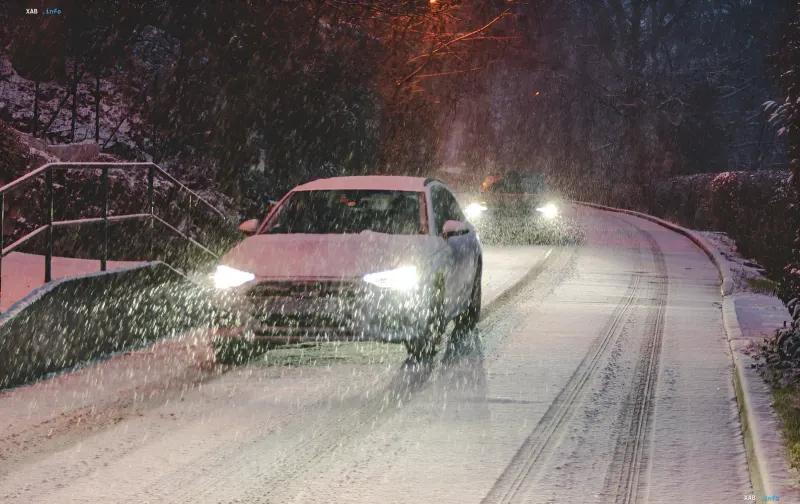
It's snowing outside, but the car is still on summer tires. This is a situation familiar to many drivers who didn't manage to swap their tires before the first cold snap. Formally, you can drive in such conditions: Ukrainian legislation does not contain an explicit ban on the use of summer tires in winter. However, legal permission and physical safety are fundamentally different things, and the road quickly reminds you of this. We break down what the law actually says, how tires behave in freezing temperatures, and why the responsibility for the consequences in such a case falls squarely on the driver.
What the law says: no ban, but a recommendation
The current Traffic Rules of Ukraine do not establish mandatory calendar deadlines for switching to winter tires and do not contain a direct prohibition on using summer tires in the winter period. The key provision here is clause 31.4.5 of the Traffic Rules ("Wheels and tires"), which contains a recommendation: when constantly operating a vehicle on roads with slippery surfaces, use tires that correspond to the road conditions. Notably, similar logic exists in the legislation of many European countries, where tire seasonality is also more often regulated by recommendations rather than strict dates.
The soft wording and its limits
Clause 31.4.5 itself pays enough attention to tires in general and contains four specific prohibitions: unacceptable tread wear, dangerous damage, mismatch of dimensions and load, and mounting different tires on the same axle. At the same time, the recommendation on seasonality is formulated as softly as possible — it applies specifically to "constant operation" on a slippery surface. In fact, this means that single, accidental use of unsuitable tires is not considered an independent violation by law. Nevertheless, the very fact of driving on summer tires in winter does not exempt the driver from the general duty to ensure the safe operation of the vehicle.
Why summer rubber "fails" in freezing weather
Summer and winter tires are designed to work in different conditions, and in a "foreign" environment, they function abnormally. The main differences between seasons are temperature and road surface condition, i.e., the presence of obstacles to grip. According to tire expert and head of the testing group Tyres Testing Group, Yuriy Datsyk, the seasonal advantages of tires are only revealed in appropriate conditions: "No matter how expensive and high-quality the tires are, they will only be effective in the season for which they are intended." Winter models are more expensive precisely because they incorporate more costly design developments and numerous tests in all possible winter conditions.
Physics of grip: rubber, sipes, and grooves
Winter tires have a special tread pattern adapted to work on ice, snow, and slush, and are made of a special rubber compound that remains soft at sub-zero temperatures and makes good contact with the micro-irregularities of a slippery surface — this ensures better grip. Summer rubber, conversely, hardens in the cold and grips the micro-protrusions of the asphalt worse; this "failure" manifests on both dry and wet surfaces, while snow and ice aggravate the problem. The second key difference is the tread pattern: winter tires have sipes, thin cuts that open upon contact with the road and grip the slippery surface with a sharp edge, whereas the smooth blocks of summer wheels simply slide over the ice. In addition, the winter tread is designed with large grooves to channel water and slush out of the contact patch, whereas summer models have narrow grooves, causing the car to "float" over the road faster — leading to hydroplaning and slushplaning.
Driver liability in case of an accident
A practical consequence of such a difference in characteristics is the shift of responsibility in the event of an accident. If an accident occurs involving a car with seasonally inappropriate tires, it will be easier to shift the responsibility onto its driver. If an expert analysis determines that due to the tire characteristics the driver could not brake in time or keep the vehicle under control, this will significantly affect the determination of their guilt. In other words, the law does not punish for the choice of rubber itself, but leaves the driver with full responsibility for ensuring that the vehicle remains controllable under the given conditions.
Practical conclusions for the driver
If you didn't manage to swap your tires in time, the driver will have to change not only the speed but also the very logic of driving: increase the distance, exclude sharp maneuvers and braking, and take into account that grip on summer tires in frost and snowfall is critically reduced. Formally, the trip is legal, but physics does not obey Traffic Rule clauses — and that is why a winter road on summer tires is full of surprises that the law does not compensate for.