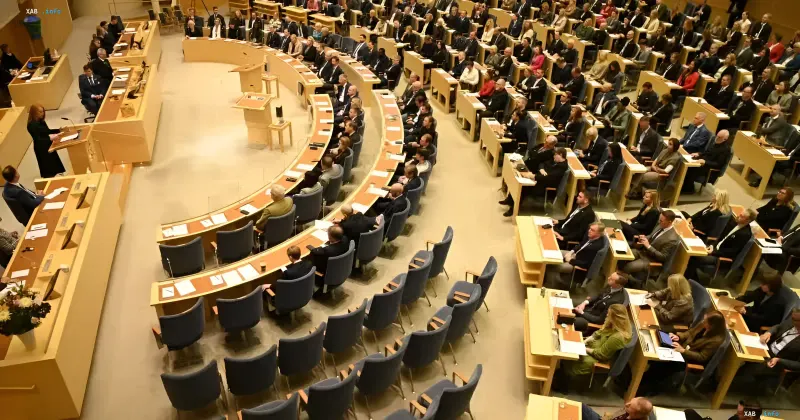
The Swedish Riksdag approved a bill lowering the age at which minors bear full criminal responsibility to 14. The document was supported by 281 members of parliament and opposed by 66, with the decisive vote coming from the opposition Social Democratic Party, which backed the ruling coalition's initiative. This is a rare case in which left‑centrists and right‑centrists converge on criminal policy, underscoring the political sensitivity of the issue ahead of the general election.
From 13 to 14: how the threshold of responsibility has changed
Initially, the government of Prime Minister Ulf Kristersson intended to lower the threshold to 13, but in June that version was withdrawn due to a lack of support in parliament. The 13‑year proposal met resistance from the majority of the 126 organizations and institutions consulted, including the police and the prison administration. In the end, the recommendation of a government‑appointed commissioner was adopted, who had previously argued that 14 was a reasonable limit for criminal responsibility.
Contradictory data
In the public sphere, discrepancies in wording persist: some foreign media outlets described the situation as "Sweden wants to lower the age" (i.e., as an intention at the discussion stage), while other publications already recorded the fact that the law had been adopted. Moreover, positions within the process itself diverged: the government team initially insisted on 13 years, while the commissioner and most consultants favored 14. The final compromise at 14 reflects precisely this internal contradiction between the coalition's political ambition and the professional assessment of law‑enforcement bodies.
A decade of gang violence as context
The decision was taken against the backdrop of a decade of gang‑related violence in Sweden, closely linked to the fight over the drug market. The Kristersson government, which came to power in 2022 with the support of the Sweden Democrats, from the outset placed the fight against crime at the center of its agenda. Lowering the age of responsibility became one of the most visible symbols of this line, aimed at demonstrating the state's toughness toward street crime.
What changes for juvenile offenders
In addition to lowering the threshold to 14, the Riksdag adopted a resolution narrowing the mitigating circumstances for minors. Under the new rules, persons under 18 may be sentenced to imprisonment for up to 18 years. Thus, the reform affects not only the point at which responsibility arises but also the upper limit of punishment, bringing the regime for teenagers closer to the adult one.
Political calculation ahead of the election
The new law is expected to enter into force on 10 September — just three days before the general election in Sweden. Crime is forecast to be one of the key issues of the campaign. According to a Demoskop poll, the left‑centrist opposition still leads the right‑centrist coalition, but the gap is narrowing: the ruling parties together with the far right may receive about 47% of the vote, while the opposition — about 51%. Under these conditions, a tough criminal bill becomes a tool for mobilizing an electorate concerned about security.