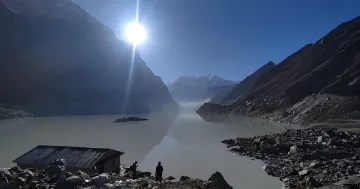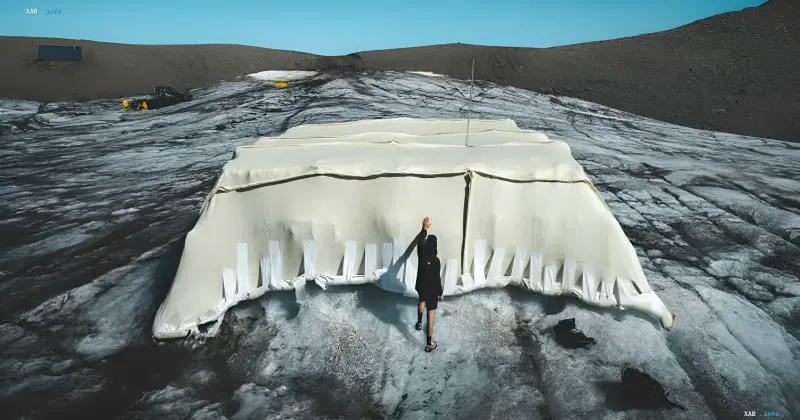
Saving the world's glaciers, according to researchers, must become a top priority for global leaders — especially after the disasters that struck Nepal and Tibet (China) in August 2025. Against this backdrop, an unusual yet apparently working experiment has been implemented in the Alps: Swiss scientists covered a section of a mountain glacier with sheets of sheep's wool to test whether this natural material can prevent heat absorption and slow down ice melting. The outcome was unexpectedly positive: the wool proved to be just as effective as conventional synthetic covers.
«Save the Wool»: How the Alpine Experiment Works
The project, named «Save the Wool», was led by the environmental organization Summit Foundation and the University of Lausanne. Tests were conducted on the Tsanfleuron Glacier in western Switzerland — a glacier about 3.5 km long. Researchers laid out two samples of wool blankets over an area of about 200 square meters and every two weeks compared the effectiveness of the wool covers with synthetic tarps traditionally used to protect ice from the heat.
Why Sheep's Wool Specifically
Typically, ice is covered with synthetic plastic sheets to prevent it from absorbing heat. The problem is that such materials do not biodegrade and create a growing burden on the environment. Therefore, in the new experiment, scientists switched to Swiss sheep's wool. According to the project data, between 40% and 70% of the wool produced in Switzerland is discarded annually. Using it as a thermal insulation and reflective layer provides a double benefit: there is no need to produce and dispose of plastic, and the wool itself can be put to work in a new field instead of being sent to a landfill.
Results: Wool Works Just as Well as Synthetics
Analysis showed that the wool helped reduce ice loss to a level almost comparable to polyethylene film. Essentially, the natural material achieved the same goal — protecting the ice from heating — but without the ecological footprint of plastic. «Now we have an environmentally friendly solution that is not just an idea, but something we can see and touch», said Eliot Gapio, a student at the University of Lausanne who participated in the study.
Not a Panacea, but Part of the Solution
Despite the positive results, researchers emphasize that this is not a fundamental solution to climate change. The key task in preventing the disappearance of glaciers remains the reduction of greenhouse gas emissions. The context makes early action particularly acute: the floods in Nepal were caused by a glacial lake outburst — as glaciers continuously melt and temporary reservoirs form, ice walls no longer able to withstand the pressure collapsed, and floodwaters rushed into the valley. Scientists warn that the Himalayas are warming faster than other regions, and natural disasters similar to those in Nepal and Tibet could become more frequent unless decisive action is taken early on.