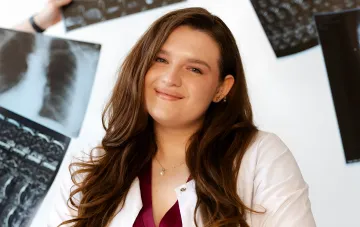
For decades, Scottish woman Jo Cameron genuinely believed she was just fantastically lucky in life because she rarely ever experienced physical pain. She broke bones, suffered burns, and cut her hands, yet practically failed to notice these injuries in daily routines. It was only after a surgical procedure at the age of 65 that medical professionals accidentally uncovered the true secret behind her unique 'immunity to pain,' which turned out to be the result of extremely rare genetic mutations.
From Ordinary Clumsiness to a Medical Phenomenon
Many people, if given the choice, would gladly prefer never to feel pain at all. However, Jo Cameron's story clearly demonstrates that living without pain sensations is by no means an absolute gift, but rather a severe hidden threat to the body. For decades, she lived, worked, and encountered various mishaps while genuinely believing she simply had an unusually high pain tolerance. She learned about burns solely from the smell of burning skin and recognized cuts only upon seeing blood on her body. Even after breaking her arm at the age of nine or surviving a car crash, she managed to get out of the vehicle and help others while ignoring her own injuries.
The Genetic Mystery of a Rare Anomaly
A turning point in her destiny came when she entered a hospital for a routine hand surgery at the age of sixty-five. Anesthesiologist Devjit Srivastava noticed that following the surgical intervention, the patient had absolutely no need for painkillers. This observation prompted a deep scientific investigation and referral to leading pain geneticists at University College London and Oxford University. Genetic testing revealed a unique mutation: a tiny missing segment in the FAAH-OUT gene combined with a mutation in the neighboring FAAH gene, which regulate pain chemical signaling, anxiety levels, and wound healing speeds.
The Paradox of Perception and the Body's Protective Function
It is tempting to imagine an ideal existence free from the fear of needles and the agonizing consequences of trauma, but in reality, pain serves a vital evolutionary warning function. Touching something hot makes us instantly pull our hand away, while a fracture stops activity in favor of medical treatment. Pain experts note that a person completely devoid of such signals loses basic self-defense skills and faces a higher risk of unnoticed severe infections. This is precisely where the main paradox lies: the very thing people desperately want to escape serves as our primary protective barrier.
Scientific Significance and Future Research Perspectives
Jo Cameron's phenomenon holds tremendous value for modern medical science and pharmacology. Scientists sincerely hope that detailed studies of her genetic variations will uncover entirely new targets for developing effective analgesics capable of helping millions of patients suffering from chronic or post-surgical pain. Jo herself fully supports these exhaustive scientific tests, striving to help those who struggle with unbearable pain daily. The Scottish woman's story leaves behind a profound philosophical paradox: sometimes the very things that annoy us the most serve as the ultimate guarantee of our physical survival.