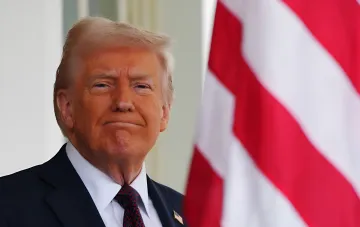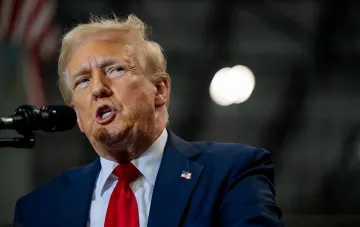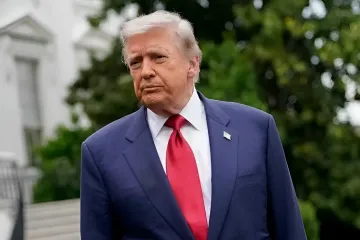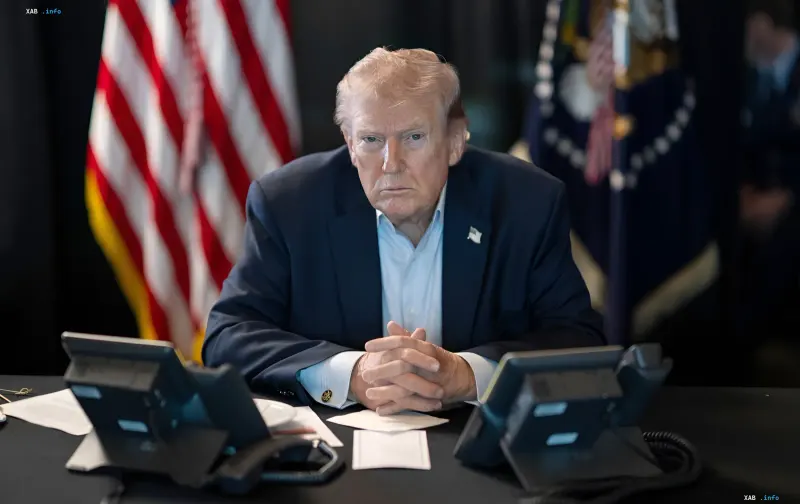
Washington publicly linked the drone attack on Saudi Arabia's strategic East-West oil pipeline to Iran. This was stated by US President Donald Trump on Saturday while speaking with journalists in Dublin, in response to a direct question on whether he considers Iran responsible for the attack on the pipeline that allows oil to be exported in bypass of the Strait of Hormuz. In his words, “I think so, probably it's them.” The statement came against the backdrop of the fact that the day before, on Friday, drones struck a key East-West oil pipeline in Saudi Arabia: pumping stations were damaged and the pipeline's operation was temporarily halted.
Trump's statement in Dublin
The American leader made the corresponding statement on Saturday in Dublin, where he was asked whether Iran was involved in the attack on the pipeline, which is vital for the region. Trump did not frame the accusation as a legally proven fact, limiting himself to an assessment of probability: in his words, Iran is “probably” behind the incident. Thus, Washington for the first time at such a high level publicly named Tehran the prime suspect in the strike on Saudi Arabia's oil artery, although no formal confirmation from Iranian authorities or independent investigations is provided in the available materials.
Contact with Riyadh and the Houthis
In addition to his assessment of Iran's involvement, Trump reported that after the attack he had a conversation with the Crown Prince of Saudi Arabia, Mohammed bin Salman, whom he called a “good friend.” Separately, the US president spoke about contact with the Yemeni Houthis, who, according to him, are backed by Iran: representatives of the group, Trump claimed, called the US administration and made it clear that they do not want direct US intervention in the conflict. “They would prefer that we not get involved, and they are letting most of the ships through,” he stated. Trump also added that there is only one country with which the Houthis are “not too satisfied,” and promised that the US would “deal with” this situation without naming it directly.
Strike on the pipeline and market consequences
The day before Trump's statement, drones attacked a key East-West oil pipeline in Saudi Arabia. As a result of the strike, pumping stations were damaged and the pipeline's operation was temporarily halted. This route is of strategic importance, as it allows the kingdom to export oil in bypass of the Strait of Hormuz — the main hub of global oil trade. According to several publications, after the pipeline was closed, oil prices rose again above the $100-per-barrel mark, underscoring the sensitivity of the global market to any disruption of supplies in the Persian Gulf region.
Contradictory data
The available materials contain a number of inconsistencies and one-sided claims that are important to take into account. First, the accusation against Iran is based solely on Trump's assessment (“probably it's them”); neither Iran nor the Houthis confirm their involvement in the strike on the Saudi pipeline in the cited sources, and no independent investigation is mentioned in the materials. Second, the statement about a phone call from the Houthis to the US administration and their willingness to “let most of the ships through” is one-sided: the group itself does not comment on this in the provided sources. Third, Trump simultaneously speaks of the attack on the oil pipeline in Saudi Arabia and of the Houthis' conduct regarding shipping, without clarifying whether these are the same episode or two related but separate directions of pressure. Finally, the “single country” with which the Houthis are “not satisfied” is not named by the US president, leaving the wording ambiguous.
Regional context
The incident fits into the broader context of the standoff around the Persian Gulf, where regional countries, according to observers, find themselves caught between Iran and the US. The shutdown of a strategic pipeline that allows bypassing the Strait of Hormuz increases pressure on oil markets and raises the importance of diplomatic channels, which Trump mentioned in Dublin — both with Riyadh and, in his words, with the Houthis. The further dynamics will depend on whether Iran's involvement is publicly confirmed and whether the pipeline's operation is restored in the coming days.