US President Donald Trump, in a post on the Truth Social platform, effectively addressed the Iranian population with a call to rise up against the current regime. Against the backdrop of the ongoing military confrontation between Washington and Tehran, the American leader posed a rhetorical question that, in the context of his previous statements, reads as a direct call to revolt: 'When will the Iranian people rise up and start fighting?' The post appeared on September 2, 2026, the day after US military forces struck targets in Iran in response to Tehran's attempts to attack shipping in the Strait of Hormuz and American service members.
'I Don't Care Whether They Sign a Trivial Agreement'
In the same message, Trump categorically rejected claims that his current strategy amounts to forcing Iran back to the negotiating table. In his words, the possible conclusion of an agreement with Tehran is not his top priority at this moment. 'I don't care whether they sign a trivial, in their view, agreement,' the US president wrote. He emphasized that he likes Washington's current position much more than a hypothetical negotiation scenario.
Control Over the Strait of Hormuz and Pressure on the Economy
Trump listed the key achievements of the American strategy: near-total control over the Strait of Hormuz — the strategic waterway through which a significant share of global oil trade passes — as well as the 'complete destruction' of the Iranian economy. 'I much prefer our current position, with near-total control over the Strait of Hormuz and the complete destruction of their economy. They are simply playing out the inevitable,' he stated. The phrase 'they are simply playing out the inevitable' indicates that, in Trump's view, the Iranian side recognizes the futility of further resistance and is trying to bargain for better terms on an already lost field.
Contradictory Data
Trump's wording contains significant rhetorical ambiguity. On the one hand, the question 'When will the Iranian people rise up and start fighting?' in the context of his previous statements — in particular, his direct call to Iranians to seize state institutions after the bombing ceased — is perceived as a de facto call to revolt. On the other hand, Trump simultaneously warned of the risks of such a scenario, noting that unarmed protesters will not be able to stand up to the armed supporters of the Iranian regime who are dealing with protest participants. Thus, his rhetoric contains two mutually contradictory messages: a call to action and a warning about its futility. Analysts disagree on the interpretation: some see it as an attempt at psychological pressure on Tehran through the threat of an internal coup, others — as a rhetorical device aimed at demonstrating a 'strong position' without any real intention of supporting an armed uprising.
Military Context: The September 1 Strikes
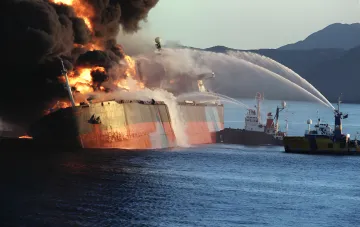
Trump's post came against the backdrop of an escalation that began on September 1, 2026, when US military forces struck Iran. According to RBC-Ukraine, the attacks were a response to Tehran's attempts to attack shipping in the Strait of Hormuz and American service members. Thus, the statement about 'near-total control' over the strait and the 'destruction of the economy' was made amid an ongoing active military conflict, not during a period of diplomatic truce.
Significance of the Statements for Regional Dynamics
Trump's address to the Iranian population with a rhetorical question about revolt represents a new element of psychological warfare within the US-Iran confrontation. If previously such signals were limited to indirect hints or statements made through third parties, then a direct post on Truth Social, addressed both to the Iranian audience and to international observers, raises the stakes. For Tehran, this creates additional internal tension: the regime is forced to simultaneously repel external military pressure and suppress potential internal instability that, in Washington's view, its own actions are provoking. For the international community, such statements exacerbate uncertainty about what the real goals of the American campaign are — coercion into negotiations, regime change, or, as Trump himself claims, simply maintaining a 'favorable position.'