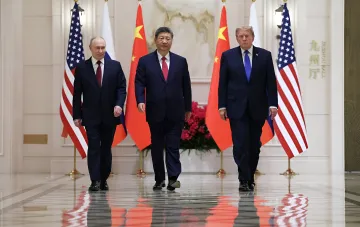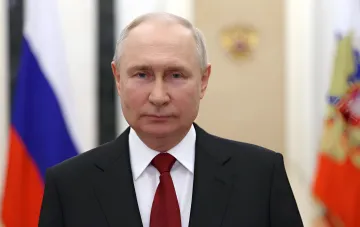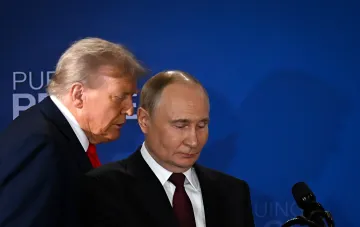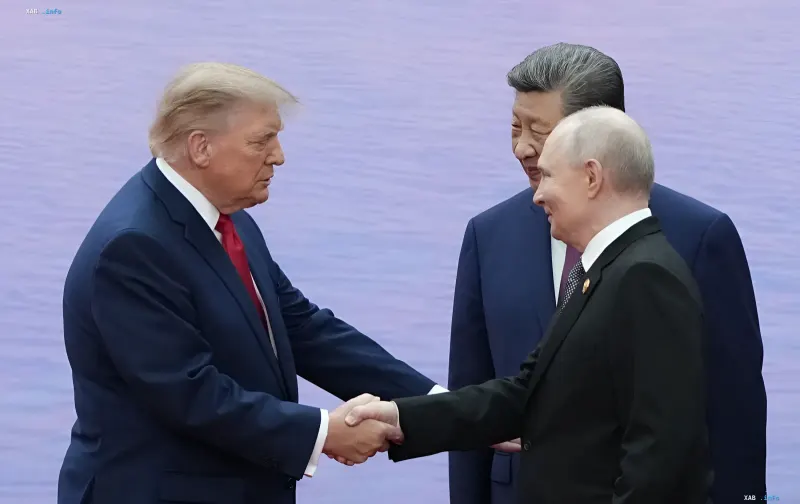
On November 19, on the sidelines of the 33rd informal APEC (Asia-Pacific Economic Cooperation) Leaders' Meeting in Shenzhen, China, the first-ever trilateral meeting between the heads of Russia, the US, and China—Vladimir Putin, Donald Trump, and Xi Jinping—is taking place. The APEC summit in Shenzhen runs from November 18 to 19, and its format provided the occasion for the simultaneous presence of the three major nuclear powers in one place. According to Russian media, the trilateral talks are scheduled at the state guesthouse of the Chinese leader, Qilin Shanzhuang, and they were originally set to begin at 14:30 local time (08:30 Kyiv time), though the schedule has shifted slightly.
Protocol and Gestures: Welcoming the Leaders
The protocol details of arrival became a notable storyline of the summit. Xi Jinping personally greeted Donald Trump at the aircraft stairs at Shenzhen Bao'an International Airport, and the two leaders embraced. Observers noted this as a deliberate reciprocal gesture: in September, when Xi Jinping paid an official visit to Washington, Trump also met him personally. Vladimir Putin, who arrived in Shenzhen earlier, was greeted at a lower level—he was welcomed at the airport by Cai Qi, head of the General Office of the Chinese Communist Party Central Committee, along with a red carpet and an honor guard.
Bilateral Contacts Before the Trilateral Summit
On the evening of November 18, the leaders of the three countries gathered at a formal reception hosted by Xi Jinping, where they met and shook hands. Reports indicate that Putin was not allowed to stand near the leaders of China and the US in the group photo: Xi Jinping gestured for him to walk past, resulting in the Chinese leader's wife standing between Xi and Putin, while Trump stood on the other side of the Chinese leader. Putin failed to speak with Trump during the formal dinner; Kremlin aide Yuri Ushakov noted that they sat at different tables during the banquet, but expressed hope that the leaders would find time to talk the next day. Meanwhile, prior to Trump's arrival in China, Putin and Xi Jinping had already held a bilateral meeting lasting over two hours; both leaders declared unity and spoke about forming a "multipolar world."
Agenda: From Nuclear Control to Ukraine
Donald Trump's administration initially stated that the key topic of the trilateral meeting would be nuclear arms control and non-proliferation. White House Deputy Press Secretary Olivia Wales emphasized that the talks are viewed merely as a "starting point" for further dialogue among the three major nuclear powers, and no agreements or reductions in nuclear arsenals are expected. The situation surrounding Iran and North Korea was also cited as possible topics. The issue of Russia's war against Ukraine (referred to in Beijing as the "Ukrainian crisis") found itself at the center of contradictory signals: the White House initially stated that the invasion of Ukraine would not be discussed at the trilateral meeting, but before departing for Asia on November 16, Trump said he intended to discuss Russia's war against Ukraine, calling it "his favorite topic." Xi Jinping has not spoken publicly about the war; according to Kremlin Spokesman Dmitry Peskov, Putin briefed Xi on the settlement of the conflict and contacts with US Presidential envoys Witkoff and Kushner in Moscow.
Format, Timing, and Expectations
China's Foreign Ministry called the summit "groundbreaking" and stated that the leaders would hold an "in-depth exchange of views" on "ensuring peace and strategic stability." Meanwhile, according to the Financial Times, the three heads of state have not actually approved a list of issues, so the summit may take place without a pre-agreed agenda; the publication also notes that due to Beijing's reluctance to play a prominent diplomatic role in the wars in Ukraine and the Middle East, the leaders may avoid substantive discussion of these topics in a trilateral format. Bloomberg notes that such an informal format is atypical for the Chinese leader, who prefers strict regulation, and that Trump, amid domestic political troubles in the US, could use the meeting to strengthen his image as a strong world leader. The Wall Street Journal, in turn, reports that Putin wants to use the meeting to discuss ending the war in Ukraine. Regarding timing, Peskov stated that no more than an hour would be allocated for the talks, whereas Ushakov specified that the duration of the meeting would be determined by the leaders themselves.