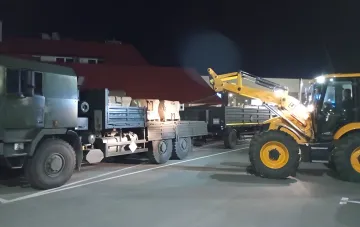
Polish Prime Minister Donald Tusk stated that during the night of September 10, Polish and Ukrainian services averted a direct threat to one of the checkpoints on the border with Ukraine. According to him, Warsaw is preparing for a scenario in which Russia, continuing to strike at trade and logistics routes, may repeat such provocations at Polish-Ukrainian crossings as well. The statement came against the backdrop of a recent Russian drone strike on a Moldovan border crossing in which people were killed.
Averting a Threat Overnight
"Last night, thanks to cooperation between our services and our Ukrainian counterparts, a direct threat to one of the border crossings was neutralized," Tusk said. The prime minister did not disclose the nature of the neutralized threat — it is unclear whether it involved a drone, a missile, or some other form of interference — but emphasized that the incident was detected and stopped during the night of September 10. The very fact of publicly confirming such an episode on the border with Ukraine became one of the most resonant signals of a rising threat level on the EU's eastern flank.
Previous Precedent: Strike on a Moldovan Crossing
Tusk referred to the events of September 9, when Russian attack drones struck the "Starkozache" international checkpoint on the Ukraine-Moldova border in Odesa Oblast; as a result, two people were killed, and among the civilian population in the vicinity there were also injured. It was this episode that the prime minister cited as an example of "provocative attacks on border crossing points," after which, in his assessment, similar actions should be expected on other directions, "in particular in Poland."
CIA Intelligence and the Readiness of the EU's Eastern Flank
On Thursday, Tusk stated that he had received "a sufficiently accurate report directly from the CIA about possible events in the coming months," which, according to him, is consistent with the warnings he had voiced months earlier. The politician called on Poland and all of Europe to plan for various scenarios and be ready not only for developments on the Russian-Ukrainian front, but also for possible provocations on the EU's eastern flank. He emphasized that the countries of Eastern Europe must be prepared for potential Russian provocations.
Arson at a Factory in Skarżysko-Kamienna
Separately, Tusk expressed his conviction that the fire at the factory producing drone components in the town of Skarżysko-Kamienna was an intentional arson and an act of sabotage. The prime minister warned that "the coming weeks and months will be difficult," linking the series of incidents — from the border threat to the arson — into a single picture of growing pressure on the region's infrastructure.
What This Means for the Region
Taken together, Tusk's statements mark a shift in Warsaw's rhetoric: from general warnings about risks to the confirmation of specific averted incidents on the border. For Poland and neighboring countries, this means a heightened readiness regime at the border and logistics hubs through which supplies to Ukraine pass, and for Brussels — an additional argument in favor of strengthening the protection of the EU's eastern flank. At the same time, the details of the nighttime incident and the nature of the "neutralized threat" remain classified, leaving room for further clarifications.