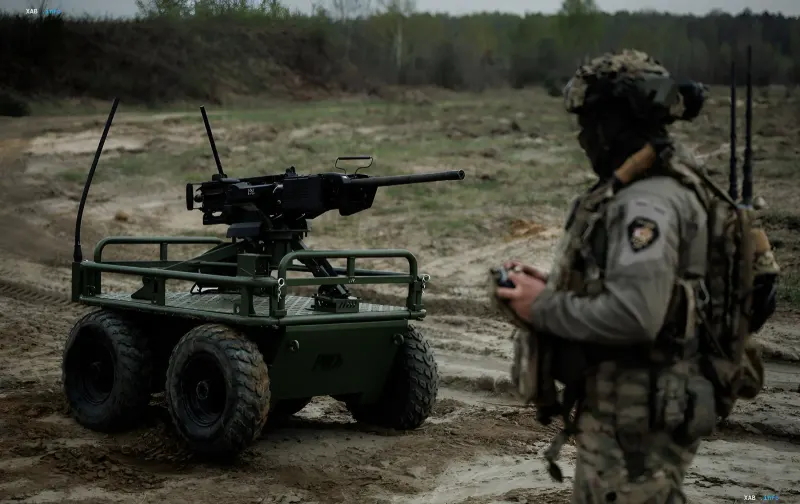
Against the backdrop of the ongoing war and the active use of unmanned ground vehicles (UGVs) in combat conditions on the frontline, a steady demand for such systems is forming worldwide. Viktor Pavlov, a UGV battalion officer of the 3rd Assault Brigade and founder of the UGV operator training school, stated in the "TSE BAZA" podcast that international interest in ground robots has moved from curiosity to practical demand: foreign parties are increasingly asking to demonstrate the systems, and a number of states are starting to establish their own production. According to him, while unmanned aerial vehicles have become a more familiar category for the global community, it is UGVs that are now coming to the forefront as objects of interest and potential import.
Information Flow as an Indicator
Pavlov notes that the growing attention to ground robots is clearly visible in the dynamics of the news flow. Six months ago, the UGV digest he curates was published once a week. Now there are two such digests — a separate one for Ukraine and a separate one for the global market — because the volume of international publications and announcements on the topic has increased manifold. According to the officer's assessment, this indicates that the topic has ceased to be niche and has entered the mainstream information contour of the defense industry.
Automakers and Defense Corporations Entering the Market
Among the new players who, according to Pavlov, "will pressure Ukraine," he highlights automotive manufacturers. In his assessment, they are no longer just getting ready, but are launching product lines and entering the UGV market. As an example, the officer cited General Motors, which, according to him, will conditionally convert pickups into unmanned ground robotic complexes. Pavlov predicts that in the near future, every major automaker will have its own unmanned vehicle: there are enough resources for this, in his opinion, since any car chassis can be converted into a UGV platform. Simultaneously, specialized military corporations are entering the market, each striving to include unmanned ground systems in its product portfolio.
Ukraine's Advantage and Its Vulnerability
According to Pavlov's assessment, the Ukrainian side possesses a key competitive advantage — unmanned control experience gained directly in combat conditions. It is real combat experience that allows for honing application tactics, identifying weaknesses, and quickly iterating designs. However, foreign companies, he says, have significantly more access to financial and production resources, which in the medium term can neutralize this experience. To maintain leadership, Ukrainian manufacturers, per Pavlov's recommendation, need to enter the market faster, build collaborations, expand beyond the country, and organize joint production with foreign partners.
Global Context: From Komodo to BladeHAUL
The trend toward expanding the fleet of ground robots is confirmed by specific international events of recent months. In September 2026, Germany's Rheinmetall tested the heavy UGV Komodo in Croatia, designed, among other things, for bridging operations. In October, Australia's Thales Australia and 3ME Technology introduced the BladeHAUL UGV with a 10-ton payload capacity, built using elements of the Bushmaster armored vehicle platform. These examples illustrate how major defense concerns from various countries are actively developing the heavy ground robot segment, supporting Pavlov's thesis that the market is rapidly filling with new participants having a serious industrial background.