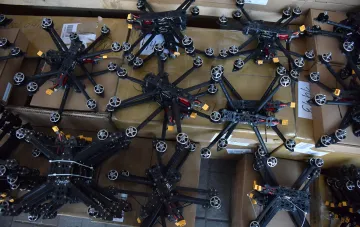
The Ukrainian defense-industrial complex is experiencing unprecedented growth: over several years of full-scale war, the industry has formed its own ecosystem, featuring specialized associations that coordinate the actions of private manufacturers. One such structure is the "Technological Forces of Ukraine" (TSU), founded in 2023 at the initiative of the enterprises themselves. In an interview with RBC-Ukraine, the association's executive director, Anastasia Myshkina, spoke about the role of industry associations, the dispute over reservation quotas, the work of the new Coordination Center, and the prospects for Ukrainian arms exports.
Associations as the Voice of Private Industry
TSU, according to Myshkina, emerged "from the bottom up": private manufacturers already present on the market consolidated so that their voice could be heard in dialogue with the state. The association positions itself as a classic industry structure, independent of political forces, and works in several directions — advocacy of industry problems, systematic interaction with the state, and developing the international track to support export activities. Myshkina emphasizes that there are several defense sector associations in Ukraine, but they do not compete; rather, they complement each other: each organization has its own specialization and resource base. Manufacturers can be members of several associations simultaneously, which, in Myshkina's assessment, will eventually lead to consolidation into one large structure.
The Reservation Dispute: 95% vs 100%
One of the key issues discussed by the industry has been the reservation quota for defense employees from mobilization. In the initial draft, the Cabinet of Ministers proposed lowering the share of reserved workers to 85%, which the industry deemed "absolutely unacceptable." Ultimately, a compromise figure of 95% was adopted, but associations, including TSU, state that they do not consider this a compromise and insist on maintaining 100% reservation. "These percentages can be cut indefinitely. In our time, the defense industry must be protected, giving people the opportunity to work, because today there is a great demand for people, a demand for scaling production," Myshkina notes. According to her, the constant procedures for re-confirming criticality and reserving specific employees take up significant time and create bureaucratic barriers where the industry believes simplification is needed.
Coordination Center: A New Obstacle or a Tool?
Parallel to the quota issues, a Coordination Center is being launched in Ukraine, which will include at least 17 representatives from various institutions. TSU views this structure as an additional obstacle to decision-making in the industry. The association continues to work with the Ministry of Defense, discussing the terms of the transition period and emphasizing the need to eliminate the re-confirmation of criticality every two months. Myshkina summarizes: "The state is complicating what, on the contrary, should be supported."
Exports, Diversification, and the Post-War Perspective
On the international track, associations are actively working on opening up exports of Ukrainian weapons and building the visibility of the domestic industry abroad. Myshkina notes that Ukrainian manufacturers do not plan to leave the country, but they are constantly diversifying their capacities. As for the post-war period, TSU is convinced that a ceasefire does not mean a drop in the need for weapons. Ukraine, according to their assessment, must constantly prepare for potential new conflicts, making the defense sector a strategically important branch of the economy for the long term.
Underground Factories and Industrial Resilience
The interview also touches on the topic of creating underground production facilities as an element of the defense complex's resilience against the enemy's attempts to paralyze an entire branch of the Ukrainian economy. Myshkina characterizes Russia's actions as aimed at stopping not just individual enterprises, but the entire industry at once, which, according to her, only confirms the strategic importance of protecting and scaling production. The association sees its task as providing the industry not only with advocacy support but also with practical tools for development under conditions of ongoing pressure.