In the first days of the full-scale invasion, Ukraine came close to losing part of the missile arsenal it had been building up since 2014. From the production site in the Zhytomyr region, missiles for the Stugna and Korsar anti-tank systems, as well as munitions for the Vyrva and Neptune programs, were managed to be evacuated in time — the facility was soon hit by Russia. According to Serhiy Pashynskyi, head of the National Association of Ukraine's Defense Industry (NAUDI), the evacuation was coordinated precisely there; the weapons that were removed were handed over to the Defense Forces and were already deployed at the front in the first months of the war.
The evacuation that saved the arsenal
The rescued systems did not remain 'in reserve': the Vyrva and the anti-tank systems were used during the defense of the Kyiv region, while the Neptune, after sinking the Moskva cruiser, laid the foundation for the rout of the Russian fleet in the Black Sea. As Pashynskyi emphasizes, the history of this evacuation shows the conditions under which the modern Ukrainian defense industry was formed: manufacturers had to simultaneously save equipment, documentation and finished products, and then relocate production, expand capacity and constantly adapt weapons to changes on the battlefield.
'Neptune': from coastal defense to strikes deep into Russia
Originally developed as an anti-ship missile, the Neptune was later adapted to strike land targets. Its long-range modification became one of the tools for striking military facilities deep inside Russian territory; according to the publication, in 2025 and 2026 Ukraine used the 'Long Neptunes' to hit important targets on Russian soil. Thus, a single program went the distance from protecting the Ukrainian coastline to becoming a tool for long-range strikes against the aggressor.
The private sector that outpaced the state
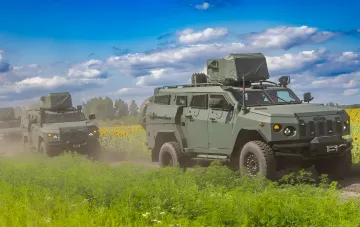
The Soviet industrial base was designed for cumbersome production cycles, rigid centralization and long-term planning, whereas the war demanded speed, flexibility and the ability to rapidly create and scale new technologies. As early as 2015, a private defense sector began to actively form in Ukraine; among its notable representatives are Ukrainska Bronetekhnika, Radionix, Ukrspecsystems and others. According to the head of NAUDI, the association's companies significantly outperform the state defense sector in the volume of products delivered, and not a single state-owned company is among the country's ten largest defense firms.
Contradictory data
There is a notable internal inconsistency in the figures here, which is important to lay out openly. On the one hand, according to Pashynskyi, the state invested 60 billion hryvnias in the defense industry's fixed assets, while the private sector received 0% of that amount. On the other hand, it is precisely the private companies that dominate the ranking of the largest defense enterprises and, by the association's assessment, outpace the state sector in deliveries. In other words, the financial support mechanism does not match the actual structure of the market. At the same time, all the figures cited (60 billion hryvnias, the 0% share, the top-10 positions) are statements by the head of NAUDI within the framework of the RBC-Ukraine special project and are not confirmed by an independent audit in the provided sources, so they should be treated as one side's assessment rather than a verified statistical fact.
Structural shift and the role of NAUDI
The association was founded in 2020 as a response by private manufacturers to the freezing of defense programs, and after February 24, 2022, one of its first tasks became coordinating the evacuation of enterprises from eastern Ukraine. Today NAUDI represents the common position of private manufacturers in negotiations with the Cabinet of Ministers, the Ministry of Defense, the National Security and Defense Council, parliament and the procurement agency, working on issues of equal rules in defense procurement, improving the regulatory framework and production cooperation. According to Pashynskyi, the nature of combat operations changes every one and a half to two years: if in 2022–2023 it was predominantly an artillery war, then since 2023 the mass use of drones, electronic warfare systems and satellite communications has made tactics at the front extremely dynamic.
Risks: capacity without orders
The key problem raised by the publication is that the capacity being created already exceeds the financial capacity of state orders, while a full-fledged mechanism for controlled export has not yet been launched in Ukraine. Without new orders and transparent rules of the game, the industry risks losing part of the potential it has built up. As the head of NAUDI summarizes, 'weapons should not be produced by the state alone' — and this thesis has become a fact, not a debate.