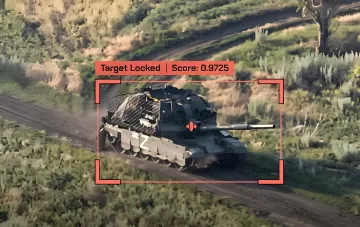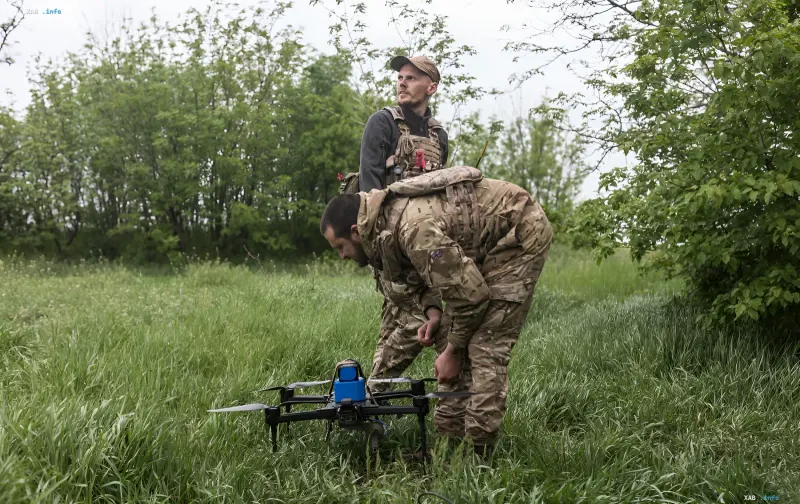
Ukraine's Delta command-and-reconnaissance system, according to The New York Times, has become one of the key factors that allowed the Russian offensive to be halted. The platform consolidates video from reconnaissance drones, signals-intercept data, and satellite imagery into a single digital environment and automatically distributes detected targets among thousands of reconnaissance and strike drones. According to the Ukrainian Ministry of Defense, it is precisely this centralized data processing that has turned scattered strikes into a multi-kilometer "kill zone," where any moving target can be detected and engaged within seconds.
The "Nervous System" of a Drone Army
Colonel Artem Martynenko, who oversees the program's development at the Ukrainian Ministry of Defense, has described Delta as the "nervous system" of the drone army. Unlike the previous practice, in which transmitting target coordinates to artillery units or strike-drone pilots required lengthy radio exchanges, the system automatically cross-references data from multiple sources and assigns each target to a specific platform. Officers receive, in real time, a full history for each object: when the equipment was first detected, how many strikes were delivered against it, and which units carried them out. In the words of commanders, this makes it possible to avoid striking already-destroyed targets and to use munitions more efficiently.
From 2014 Volunteers to a Platform of the Armed Forces of Ukraine
The roots of Delta go back to 2014, when a group of Aerorozvidka volunteers sought to speed up the transfer of data from reconnaissance drones: previously, targets often "disappeared" before their turn came over the radio. Initially, the system was a shared digital map, and the project's funding, reportedly, was provided by NATO. Widespread adoption in the army began only with the full-scale invasion of 2022 — it was with the help of Delta, Kyiv claims, that the weak points of Russian columns advancing on Kyiv were detected in a timely manner. In 2024, the system passed an information-security audit to NATO standards for the first time in history, and last year Defense Minister Denis Shmygal signed an order to deploy it at all levels of Ukraine's defense forces.
Shortening the Time from Detection to Strike
Delta's main practical effect is the radical acceleration of the "detect–strike" cycle. According to commanders, the time between target detection and the strike has shrunk from roughly 20 minutes to 3–5 minutes. The Ukrainian outlet 24tv, citing the Ministry of Defense, further emphasizes the economic efficiency of such strikes, estimating the cost of destroying a single enemy object at around $3,000. Commanders stress that the combination of speed and low unit cost makes the system economically advantageous compared with traditional means of engagement.
Recognition from the US and NATO: Ukraine in the Lead
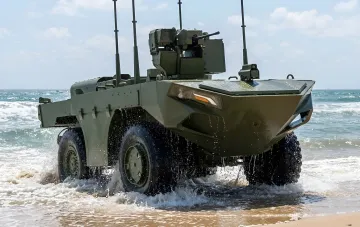
Ukraine's technological edge became visible to Western partners as early as exercises in Estonia, where, reportedly, Ukrainian drone units outperformed an Alliance formation in simulations. US Army Secretary Daniel Driscoll publicly called Delta "absolutely incredible" and acknowledged before the Senate that the US armed forces are still catching up to Ukraine: their system, unlike Delta, does not yet unify all drones, sensors, and strike assets into a single network. In the fall, Delta became the key platform at the large-scale NATO REPMUS 2025 exercises, coordinating more than 100 maritime, underwater, ground, and air drones from participating countries.
Artificial Intelligence and the Future of Delta
Artificial intelligence is now being integrated into the system: algorithms are being trained on millions of hours of drone video. A separate AI assistant, SPECTR, has been developed — essentially a chatbot for the battlefield that helps commanders make decisions faster when planning attacks. In this way, Delta is evolving from a data-aggregation tool into an adaptive decision-support system capable of independently proposing engagement priorities.
Contradictory Data
The sources contain minor discrepancies in figures and details. For instance, the main publication (RBC-Ukraine, citing the NYT) gives the time from detection to strike as "3–5 minutes," whereas the UNIAN headline records "three minutes." The role of NATO is also emphasized differently across materials: in one account it is named the initial funder of the 2014 project, in another a partner that learned of the system's advantage only at the exercises. These discrepancies do not change the overall picture, but the spread of versions should be kept in mind when citing specific figures and dates.