The Ministry of Veterans Affairs of Ukraine has launched a pre-pilot project for psychological and psychosocial support, aimed not only at the veterans themselves but also at their families. This is reported by RBC-Ukraine, citing an official statement by the ministry on Facebook. Currently, specialists are testing three different models of family rehabilitation in the Vinnytsia, Ivano-Frankivsk, and Rivne regions, with the full-scale launch of experimental Family Recovery Centers across the country scheduled for 2027.
Why the focus has shifted to the family
According to the Ministry of Veterans Affairs, the return of military personnel to civilian life affects not only the veteran but also their loved ones. Families have to adapt to radical changes, rebuild relationships, and overcome the consequences of the stress they have experienced. The key feature of the new approach is working with the entire family system, rather than with an individual. The programs are designed to strengthen family and social ties, as well as to prevent the so-called secondary traumatization of loved ones, primarily children, who may react acutely to the emotional state of their parents.
Three pilot sites: what is happening in the regions
In the Vinnytsia region, the program is being implemented at the "Nash Dim" treatment and rehabilitation center in the village of Novi Obikhody. By the end of 2026, 12 families from various communities in the region are expected to complete a seven-day course. Psychologists work with veterans, their partners, and spouses together. In addition to psychological support and health procedures, families receive consultations on obtaining status, benefits, housing, and land issues, as well as on veteran sports and starting their own business.
In the Ivano-Frankivsk region, at the "Karpaty" sanatorium in the Yaremche community, the "Power of Two" program, designed for approximately 30 veteran couples, is ongoing from October to December 2026. Participants work on overcoming fatigue and restoring mutual trust. The program includes mindfulness practices, work with trauma therapists, body therapy, film therapy, fairy-tale therapy, and activities with plaster and stone. The project is supported by the "Nova Ukraine" charitable foundation and the "Marlog-Kadutsei" non-governmental organization.
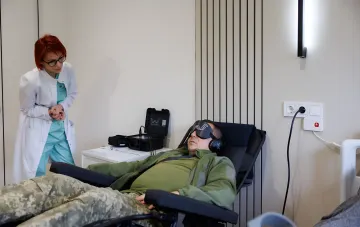
In the Rivne region, the regional clinical hospital is preparing to receive veteran couples by the end of 2026. In the first phase, the program is designed for five couples, with the stay duration ranging from eight to 14 days. The recovery plan for each family is adapted individually: participants attend individual, couples, and group therapy, engage in art therapy and hippotherapy. If necessary, veterans undergo medical examinations. Upon completion of the program, families receive a plan for further support and self-regulation.
What happens after the pilot
The pre-pilot project serves as a "living laboratory": specialists are evaluating family selection criteria, facility requirements, program costs, and training needs. Based on these findings, the Ministry of Veterans Affairs plans to launch an experimental project of Family Recovery Centers in 2027 and gradually scale the proven model throughout Ukraine. Thus, by 2027, the ministry aims to have a standardized package of services that can be replicated in regions without a loss of quality.
Broader context: reform of the veteran support system
The launch of family centers is part of a broader reform that the ministry is implementing in 2026. Previously, the Ministry of Veterans Affairs announced the simplification of the procedure for obtaining combatant status, including transferring a portion of document circulation and interagency information exchange to electronic platforms. Parallel work is underway to modernize the payment system and psychological assistance, which Minister of Veterans Affairs Vitaliy Kim discussed in a recent interview. In this logic, family rehabilitation becomes a connecting link between medical, social, and legal support for the veteran and their environment.