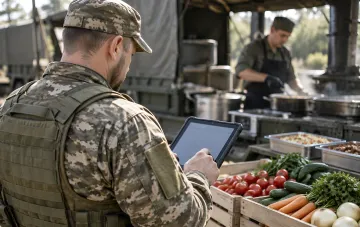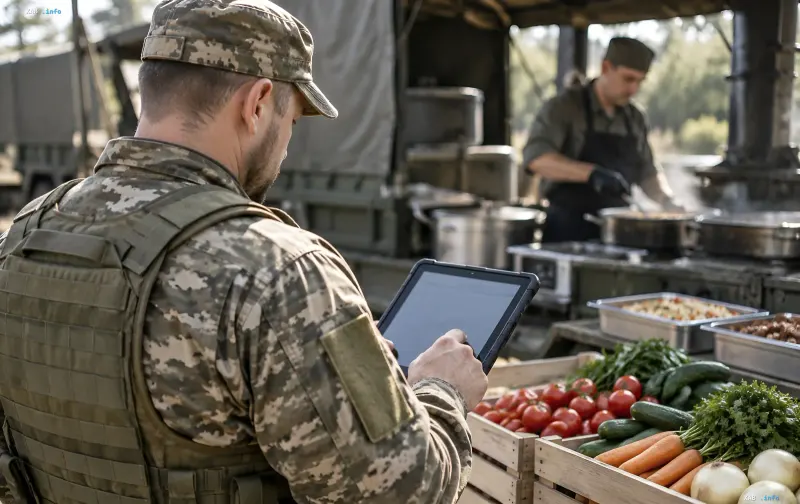
Feeding the military of Ukraine is not merely a matter of satiety, but a complex logistical and administrative system covering hundreds of thousands of people on the front lines and in the rear. Depending on service conditions, some units receive three or four hot meals, while others rely on 24-hour individual combat rations. All procurement of food, rations, and food service property is processed through a unified digital system, with the assortment formed based on a universal catalog of 360 items. RBC-Ukraine, citing data from the Ministry of Defense of Ukraine, analyzed who is responsible for providing food to the army, how the new digital procedure works, and what has changed since autumn 2026.
Who Determines Needs and Who Procures
All service members of the Armed Forces of Ukraine and the State Special Transport Service (SSTS) are entitled to state-funded meals, whether deployed at the front or serving in the rear. Food, rations, and food service supplies are procured by the Defense Procurement Agency (DPA). The agency announces tenders, concludes contracts with suppliers, and monitors contract performance and logistics. Food requirements are determined by the General Staff of the Armed Forces and the SSTS. Based on this, the Ministry of Defense defines the list of necessary products and rations, along with budget-aligned pricing. At the unit level, the commander is directly responsible for organizing food, determining the required format based on mission demands and service conditions. The chief of the food service draws up the menu, calculates quantities, and places orders. On the front line, where combat rations are used, the unit commander submits a request for the required amount.
Hot Meals, Field Stations, and Rations: Three Support Formats
The foundation of the military diet is hot food. Whenever possible, it is prepared from chilled meat, fresh seasonal vegetables, fruits, and other staples. Depending on service conditions, personnel receive three or four meals per day. Four meals a day are provided for aircrew, Navy personnel, and lyceum students: in addition to breakfast, lunch, and dinner, they receive a second breakfast or dinner. This format is typically used in permanent deployment locations, training centers, military universities, and near front-line bases where kitchen facilities can be set up and supply lines maintained. In higher-risk environments, ingredients with longer shelf lives, such as frozen meat, canned goods, and biscuits, are used. In such cases, field catering stations are established as the situation permits. Menus are designed based on the combat mission location, baseline rations, and available stock. If hot food cannot be provided, troops are supplied with 24-hour combat rations containing three full meals: breakfast, lunch, and dinner.
New Alternative Combat Ration for Front-Line Troops
The Ukrainian Armed Forces use two types of field rations: the daily field ration and the reinforced daily field ration. In October 2026, a new alternative ration was approved. It features higher caloric density and includes special heating elements and water purification supplies. This set is intended for specific categories of personnel in the Armed Forces and SSTS directly engaged in combat operations on the front lines. Thus, the army has acquired a third, more functional option for daily sustenance in the most severe service conditions.
Universal 360-Item Catalog and Updated Descriptions
Military catering is organized via the Universal Catalog of Food Items of the Armed Forces of Ukraine, which contains 360 items. Since June 2026, all catalog items have featured updated descriptions: caloric information has been added to every product, and nutritional data regarding protein and fat content per 100 grams has been added to meat, fish, and dairy items. The range accounts for diverse personnel needs, including Halal and Kosher certified products, as well as options for those abstaining from animal products for ethical, religious, environmental, or other reasons. The catalog is formed by the Logistics Forces Command and approved by the Ministry of Defense. The DPA has already announced 2027 procurement under these updated requirements.
The DOT-Chain Food Digital System: From Paper Invoices to a Unified Loop
Food orders for military units are managed via the DOT-Chain Food digital system. It covers the entire food supply process—from request submission to delivery confirmation, invoice processing, and signing of acts. Since November 2026, all food supply documentation for the Armed Forces and SSTS must be processed within this system. Previously, document management was paper-based: requests were sent to suppliers via email, while invoices, acts, and complaints were handled physically. Transitioning to a unified digital loop reduces approval times, minimizes document loss, and allows for real-time tracking of food movement from the supplier to the unit.