On the 35th anniversary of Ukraine’s independence, RBC-Ukraine has put together a selection of seven brands and companies that, over the past quarter of a century, have ceased to be mere suppliers of goods and services and turned into an element of the everyday experience of millions of citizens. These are companies whose names need no explanation, whose products have become part of family traditions, and whose history has become intertwined with the history of the country itself. At the center of the publication is the perfume and cosmetics chain BROCARD, the Avesterra group (chicken meat production), as well as the logistics operator Meest, the law firm Liga Zakon, the furniture retailer JYSK, and other players whose logos are today as familiar to Ukrainians as the flag on a building’s roof.
The moment when a brand stops explaining itself
Co-founder and business manager of the BROCARD chain, Yuri Hatkin, recalls a key episode that became a personal turning point for him. In 2003, while walking the sales floor of a store in the “Globus” shopping center on Maidan Nezalezhnosti in Kyiv, he heard a woman say over her mobile phone: “I’m at BROCARD.” No address given, no explanation of what kind of place it was or where it was located. Just “I’m at BROCARD” — as if the person on the other end already understood everything. It was exactly at that moment, according to Hatkin, that it became clear: the brand had made it. It had stopped being a name on a sign and had become a landmark, a common point of reference for an entire generation.
Generations that grow up together with the shelf
The connection between BROCARD and its customers was built not through advertising campaigns but through thousands of “ordinary encounters”: the first adult perfume, a gift for a loved one, the first lipstick, and then — buying one for their own daughter. Today, people aged 13 to 80+ shop at the chain, and, according to company data, three to four generations of beauty enthusiasts have “grown up” with BROCARD. The scale of this connection is captured in the numbers: 68 stores in 22 cities of Ukraine and more than 2.7 million registered customers. The chain’s mobile app has been downloaded by over 2 million users.
War as a test of a brand’s “belonging”
A telling moment for testing the depth of a brand’s connection with society was Russia’s full-scale invasion in 2022. BROCARD continued to operate in occupied and frontline areas, restoring damaged stores and opening new ones. At the same time, the company directed funds to support the Defense Forces of Ukraine: over the course of the war, according to company data, the volume of such spending exceeded 330 million hryvnia. The RBC-Ukraine editorial team emphasizes: a brand’s presence in people’s lives is not only about what happens inside the store, but also about the ability to stay close at the moment when the familiar order of the country is changing.
From selling — to experience: a new script for the visit
Over a quarter of a century, beauty retail itself has transformed: the customer comes not only for a jar of cream or a bottle of perfume, but also to “catch their breath,” to spend time in a beautiful space, to socialize. BROCARD is shifting the focus from the transaction to the experience. A vivid example is BROCARD Beauty Garden, a space of over 1,700 square meters in the Respublika Park shopping center in Kyiv. At the entrance, hostesses help you get your bearings: where to test a fragrance, undergo a skin diagnosis, or have a coffee. For those who want to go without a consultant, baskets with a sign reading “No beauty expert needed” are provided. The company emphasizes: if a customer tested a fragrance, smiled, and left without a purchase — that too is part of the experience. Not every visit has to end with a receipt.
Technology does not replace live contact
The website, mobile app, and social networks provide additional channels of interaction: searching for new products, reading about skincare, selecting a fragrance, watching beauty content. However, as noted at BROCARD, technology merely expands the ways of staying in touch with the brand and does not change the main idea. “Today, the store’s main competitor is the sofa,” the company jokes, meaning that almost everything can be ordered without leaving home. At the same time, beauty retail will become even more digital in the future, but live communication, according to the management’s conviction, will remain irreplaceable: artificial intelligence can talk about the notes of a fragrance, but it will not feel how it unfolds on the skin, nor will it see the moment when a person smiles upon finding the right shade of lipstick.
Six logos against the backdrop of Motherland Monument
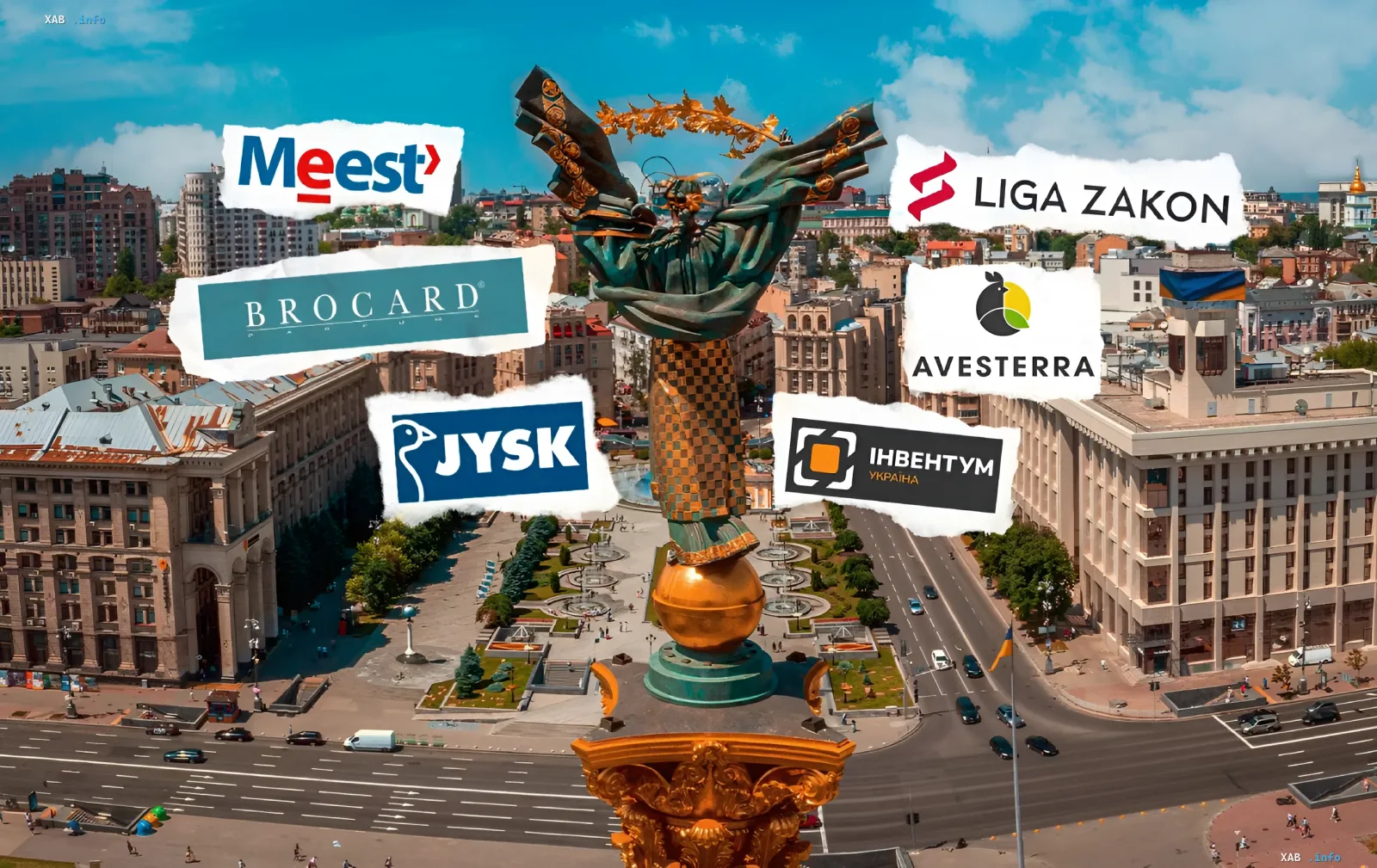
The visual row for the RBC-Ukraine publication — the logos of Meest, Liga Zakon, BROCARD, JYSK, Avesterra, and one more company — is overlaid on an aerial photograph of the Motherland Monument in Kyiv. This is no accidental metaphor: the brands in question are perceived as part of the urban and national landscape. Avesterra Group, one of the country’s largest chicken meat producers, stands behind such recognizable brands as “Epikur” and “Chebaturochka” — and their story, like BROCARD’s, begins with the name ceasing to be merely a label and becoming part of the family table. Over 35 years of independence, Ukraine has created an entire layer of such “home-grown” brands, and it is precisely their collective sum that forms what the editorial team calls the “Ukrainian DNA” of consumer choice.