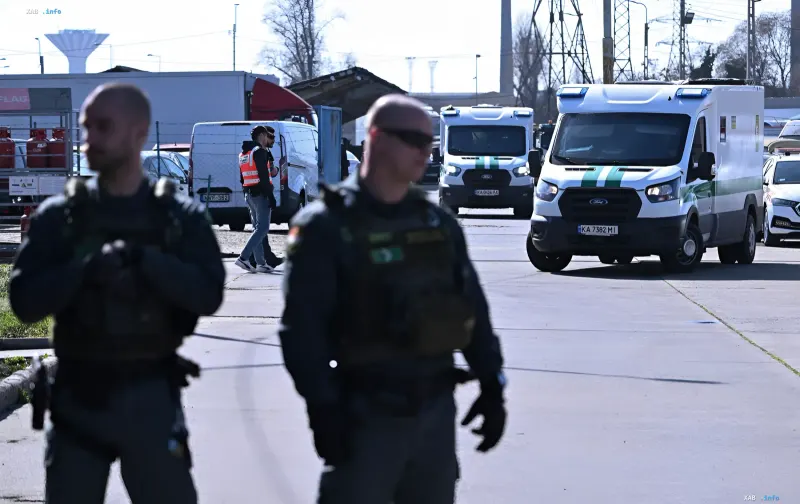
Ukrainian Ambassador to Hungary Fedir Shandor told RBK-Ukraina that the case involving the kidnapping of Ukrainian cash-in-transit guards and their cargo on Hungarian territory is 95% solved, with the remaining 5% concerning the punishment of the guilty parties. According to him, the incident is classified as terrorism under international norms — an attack simultaneously on the financial sector and on people. As of publication (August 21, 2026), the victims, vehicles, and financial assets have already been returned, and the deportation of the cash-in-transit guards has been canceled.
Classification as Terrorism and the Role of Russian Intelligence
Shandor emphasized that the detained Ukrainians were injected with various tranquilizers, and, in his assessment, Russian intelligence stands behind the entire operation. The ambassador described the event as an attack on people, an affront to human dignity, causing physical harm and damage to vehicles. He also suggested that the investigation might reveal “fantastically high-ranking names” of those who gave personal orders, noting that even ordinary officers were unwilling to carry them out.
Return of Personnel, Equipment, and Assets
According to the ambassador, at this stage, all seven detained workers, armored bank vehicles, and the transported financial savings have been returned. Additionally, the Hungarian side canceled the deportation of the affected Ukrainian bank employees, which became one of the practical results of Kyiv’s pressure on this case.
New Phase: Hungary Mitigating Reputational Risks
Shandor noted that the case has entered a new phase, in which the Hungarian side is acting “even more actively than the Ukrainian side,” seeking to mitigate reputational risks inflicted on its own banking sector. The ambassador stated that, in effect, piracy was committed on Hungarian territory, which the state not only failed to control but facilitated, warning that a similar incident could happen to Hungarian transport on the territory of Slovakia or Poland.
Contradictory Data
There are inconsistencies in the versions of the parties and in the formulations of the sources themselves. On one hand, formally, the kidnapping was carried out by Hungarian law enforcement, delivering the people and cargo to the territory of the Hungarian Anti-Terrorist Center; on the other — the Ukrainian ambassador directly points to Russian intelligence as the organizer, creating a discrepancy regarding who bears responsibility for the order. Furthermore, in the primary materials, the cash-in-transit guards are referred to as employees of “Sberbank,” raising questions about whether the personnel belong to the Ukrainian or Russian financial structure and requiring additional verification. Finally, the classification of the event as “terrorism” is the position of the Ukrainian side and has not yet been confirmed by a Hungarian court.
Chronology of the Incident
The scandal erupted on March 5, when Hungarian law enforcement seized seven workers and a cash cargo — $40 million, €35 million, and 9 kg of gold. The armored bank vehicles were traveling from Austria to Ukraine, after which the money and equipment were delivered to the territory of the Hungarian Anti-Terrorist Center. The detained cash-in-transit guards later spoke of cruel treatment: interrogations lasted a day, and according to media reports, “KGB methods” and forced injections were used against the Ukrainians, which by their nature could be equated to torture.