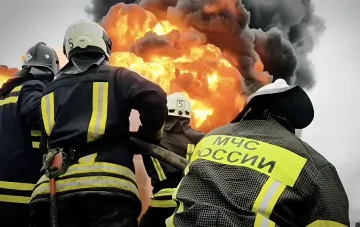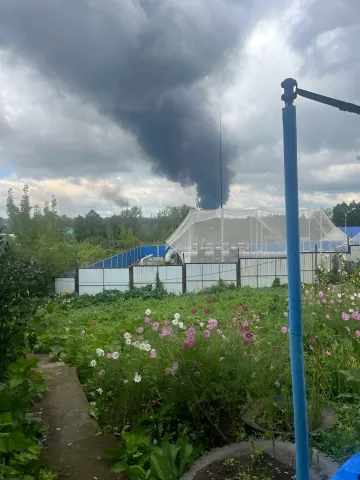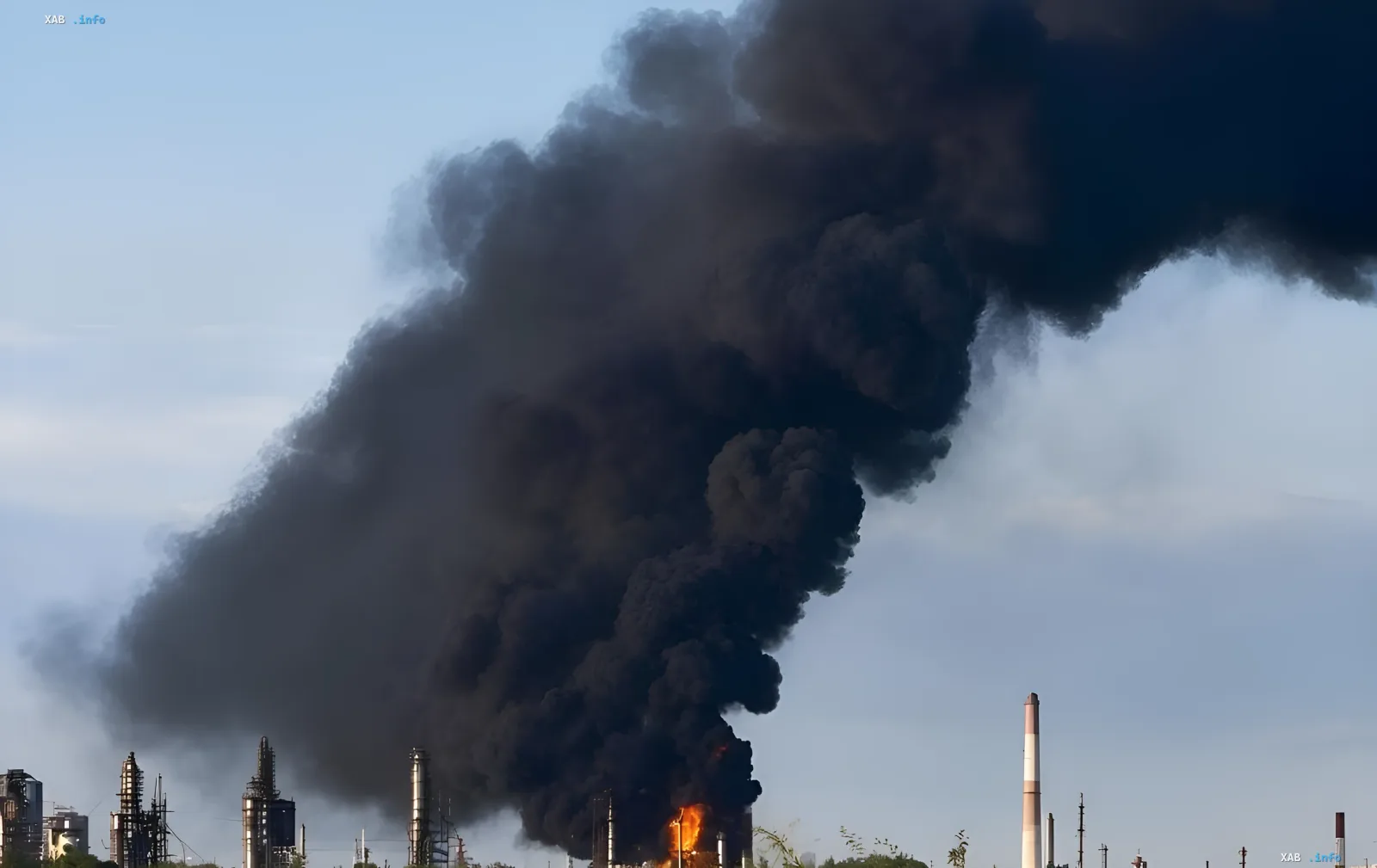
On the night of August 4, a series of powerful explosions rocked the Samara region. The target of the attack was the Syzran Refinery (Syzran NPZ), one of the key enterprises of Russia's fuel and energy complex. A thick column of black smoke rose above the plant's territory, visible from a distance. Official comments from authorities regarding the scale of the damage have not yet been received, however, the fact of the strike is confirmed by monitoring channels and statements from Ukrainian military officials.
Confirmation of the attack and source of information
Information about the attack was disseminated by the publication RBK-Ukraine, citing the head of the Center for Countering Disinformation under the National Security and Defense Council (NSDC) of Ukraine, Defense Forces officer Andriy Kovalenko. According to him, the strike was carried out by Ukrainian unmanned aerial vehicles (drones).
Witness accounts and data from monitoring Telegram channels Exilenova+ and Supernova+ confirm the picture of events: a series of explosions were heard in Syzran, after which a high column of thick smoke rose above the industrial zone. Visual materials show the scale of the fire and smoke, characteristic of fires at oil refining facilities.
Strategic significance of the facility
The Syzran Refinery is not just a plant, but a strategic asset within the structure of the company Rosneft. The enterprise, whose construction began back in 1939, is one of the oldest in Russia. It is located on the banks of the Volga, forming part of the Samara oil refining hub along with the Kuibyshev and Novokuibyshevsk plants.
The nominal capacity of the plant is up to 8.9 million tons of oil per year. A wide range of products are produced here: from gasoline and diesel fuel to aviation kerosene. According to data, the fuel produced here is used both to supply the occupation forces at the front and to supply the central regions of the country.
History of strikes and infrastructure vulnerability
Despite the fact that Syzran is located more than 800 kilometers from the Ukrainian border, the enterprise has repeatedly become a target of attacks. Ukrainian drones struck the plant in December 2025, as well as in March, April, and July 2026.
One of the most significant incidents was the strike on May 21, when a drone hit one of the primary processing units. As a result, the CDU-6 unit, which provided more than 70% of the enterprise's capacity, was put out of order. Restoration work took more than a month, which clearly demonstrated the vulnerability of Russian energy facilities to drone attacks.
Synchronization of attacks and Russia's response
The attack on the Syzran Refinery was not an isolated event. On the same night, Ukrainian drones struck logistics infrastructure in other regions. In the Moscow suburb of Chekhov, warehouses of the Wildberries marketplace were attacked, resulting in a fire in the private sector. In the village of Krasny Bor in the Leningrad region, a logistics complex covering more than 150,000 square meters was damaged.
The escalation of attacks on deep rear infrastructure is forcing Russia to reconsider its air defense tactics. It was previously reported that Russia has significantly increased the use of A-50U long-range radar detection aircraft due to concerns about Ukrainian cruise missiles. In particular, on July 7, four such aircraft were simultaneously airborne — effectively the entire combat-ready fleet of Russia, which indicates the tension in the airspace.