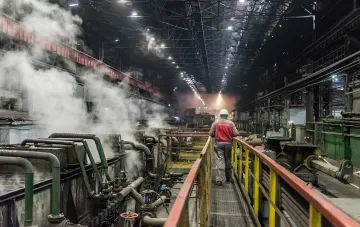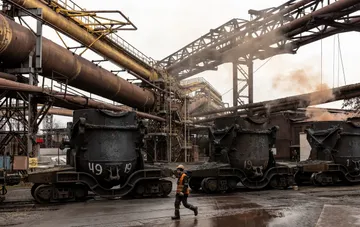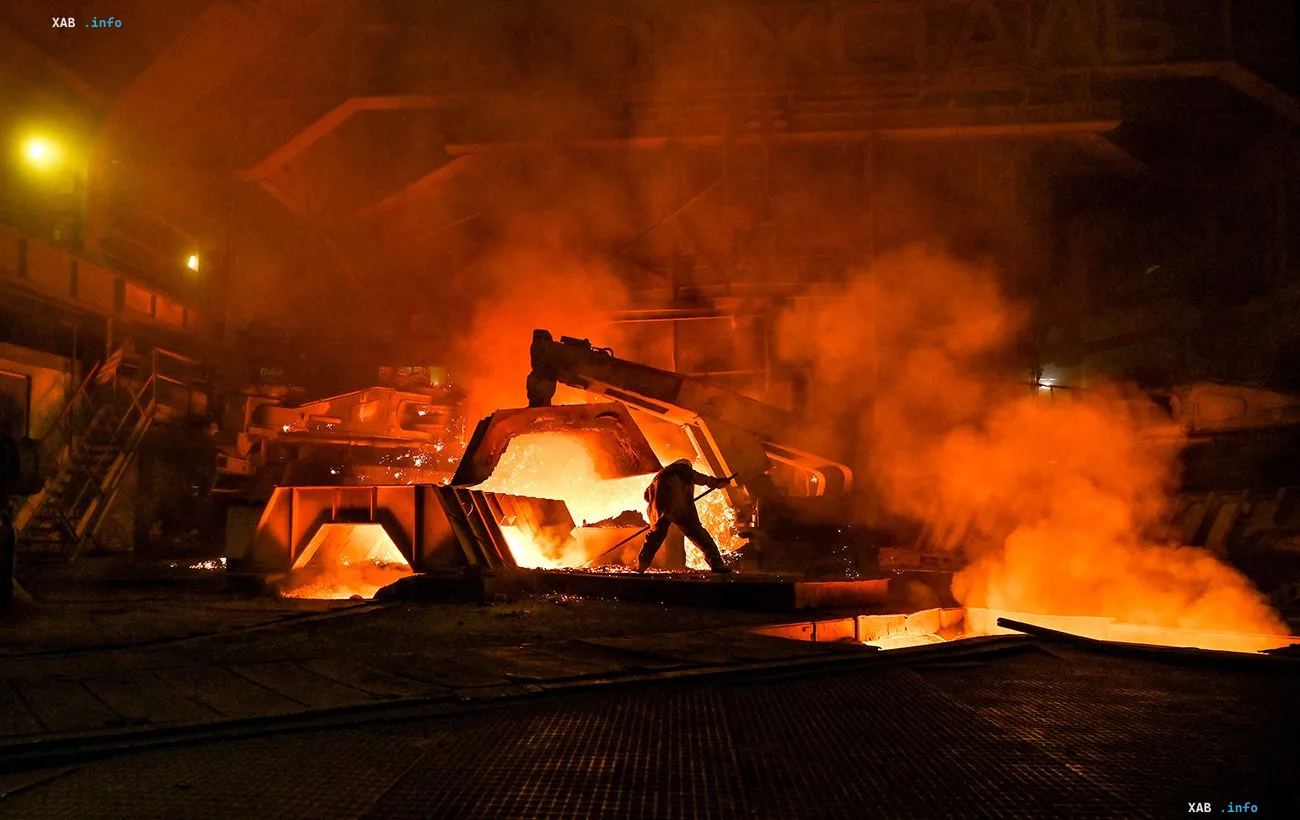
Ukraine's metallurgical industry is going through one of the deepest crises of the entire full-scale war. The simultaneous pressure of Russian strikes on industrial facilities, electricity shortages and high energy costs, the blockade of Black Sea ports, rising railway tariffs and new European Union trade restrictions has led to the fact that the country's key steel mills are effectively shut down. According to data published by RBC-Ukraine citing a Censor.NET report, steel production in Ukraine fell by 57.3% in August 2026, and at Metinvest they note that the new challenges have placed the industry "on the brink of survival".
Mill Shutdowns and a Chain Reaction Across Related Sectors
Following a series of Russian attacks in August and September 2026, Zaporizhstal, Kametstal and ArcelorMittal Kryvyi Rih — the three largest metallurgical enterprises in the country — were taken out of operation. The shutdown of the mills immediately affected adjacent sectors: production at the mining and beneficiation plants fell by roughly 40% in August. According to GMK Center CEO Stanislav Zinchenko, the mining and metallurgical complex accounts for about 40% of Ukrzaliznytsia's workload, 30–40% of the ports' freight base and 10–20% of the machine-building sector's utilization. Thus, further production cuts carry risks that extend far beyond metallurgy itself.
Logistical Collapse and Energy Shortages
The crisis is compounded by a set of logistical and energy problems. The blockade of the seaports has deprived the mills of their main export channel: in August 2026, pig iron exports from Ukraine fell to zero. A record collapse has also been recorded for steel semi-finished products — foreign sales dropped by 76% compared to July 2026 and by 71% year on year. At the same time, railway tariffs are rising, there is a shortage of locomotives and wagons, and the high cost and instability of energy supply make it economically unviable to restart even the partially preserved capacities. According to industry estimates, without the stable operation of the Black Sea ports the mills will not be able to reach economically viable production volumes.
The European Market: New Quotas and CBAM
A separate blow to the industry has been the new EU trade restrictions that took effect in July 2026. Previously, more than 80% of Ukraine's metallurgical exports were directed to the European market. The new quotas could cut supplies of Ukrainian metal products by 60% compared to 2025 — to roughly 1.05 million tonnes. At Metinvest, they estimate that together with the costs of the CBAM (Carbon Border Adjustment Mechanism) mechanism, the new restrictions could cost the company almost 700 million euros in export revenue per year. "A European market closed to us means an inevitable reduction in capacity and the shutdown of factories," Stanislav Zinchenko stated. Among the industry's proposals are negotiations with the EU to ease the quotas for Ukrainian steel and the introduction of a special CBAM regime for the duration of the war.
Loss of the Domestic Market and the Social Burden
In parallel, Ukraine is rapidly losing its domestic market as well. If the share of imports in steel consumption used to be 10–20%, it has now approached 50%: of the roughly 4 million tonnes of domestic consumption, about 2 million tonnes now come from imports, mainly from Turkey and China. The social risks of the crisis are also significant: according to GMK Center, the industry provides about 70,000 direct jobs and a further roughly 280,000 in adjacent sectors. The large mills remain key employers and taxpayers in Zaporizhzhia, Kryvyi Rih, Kamianske and other industrial cities. Metallurgy's contribution to the country's GDP has shrunk from about 10.3% before the full-scale war to roughly 5.5% last year.
Contradictory Data
Open sources show discrepancies in assessments of the scale of the industry's shutdown. According to RBC-Ukraine and Censor.NET, steel production in August 2026 fell by 57.3%. At the same time, the outlets Dengi.ua and NV (citing the Financial Times) use the wording that Russian strikes have taken out 90% of Ukraine's metallurgical capacity and that "metallurgy is no longer there." The difference in figures may be explained by differing methodologies: 57.3% is the actual reduction in the volume of steel produced in a month, whereas 90% may refer to the total design capacity that has been taken out of operation or is running on limited lines. The exact timelines for restoring the shut-down enterprises are not defined at the time of publication: specialists are assessing the damage to Zaporizhstal and Kametstal, and according to Zinchenko, restoring large-scale capacities may take a long time due to the need to clear rubble, manufacture new equipment and the difficulty of delivering it under wartime conditions.
Outlook: the Risk of Losing the Production Base
The industry warns that without comprehensive state and international support, Ukraine risks simultaneously losing its export markets, its domestic market and the production base itself, on which the railway, the ports, machine-building and the economies of entire industrial regions depend. Restoring maritime logistics and the negotiation track with the EU on quotas and CBAM remain critical. Without effective steps in both directions, experts assess that the industry may move from a deep crisis to an irreversible loss of competitiveness in the global market.