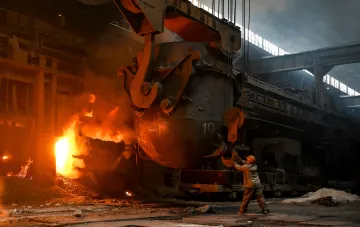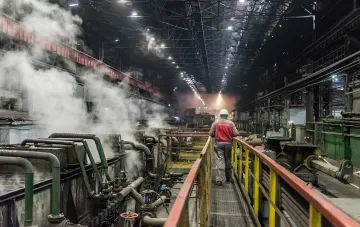

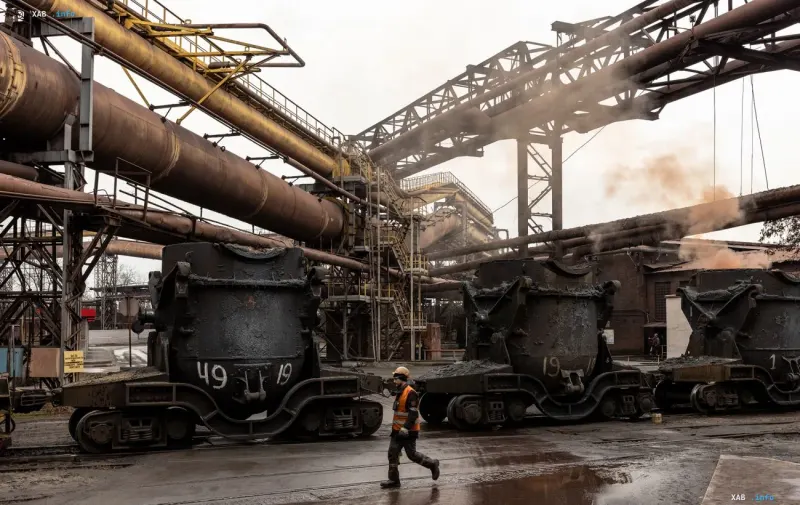
Ukraine's metallurgical industry is going through the most difficult period of the entire full-scale war. According to data published by "Economic Truth" and reported by RBC-Ukraine, steel output in August 2026 fell by 57.3% year on year — to 277 thousand tonnes. Pig iron production dropped by 65.6%, and rolled metal output by 57.4%. Iron ore mining in the first half of the year declined by 18.8%, while rolled metal exports were cut in half. The share of the mining and metallurgical complex in the country's GDP, which stood at around 10.3% before the start of full-scale hostilities, fell to 5.5% by 2025. According to Stanislav Zinchenko, director of GMK Center, the industry has found itself in a situation of a "perfect storm," where Russian missile strikes compound structural problems in logistics and the market.
Three plants under attack: losses and the human factor
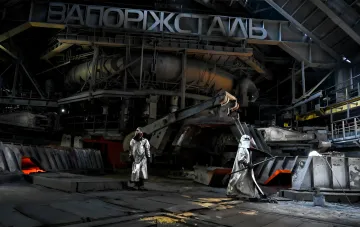
The heaviest damage was sustained by Zaporizhstal, Kametstal, and ArcelorMittal Kryvyi Rih. The first two enterprises are currently fully shut down: specialists are assessing the scale of the damage and the possibilities for restoration. According to available data, only Zaporizhstal and Kametstal were hit by 22 ballistic missiles since the beginning of August, of which 17 struck the Zaporizhzhia plant. As a result of the attacks, 13 workers were killed and a further 55 were injured. ArcelorMittal Kryvyi Rih also suffered significant damage, although it was not fully shut down.
Currency earnings, employment, and import dependence
The crisis extends far beyond the industry itself. Metallurgy remains one of Ukraine's largest sources of foreign currency earnings and provides jobs for around 270 thousand people. In 2025, the mining and metallurgical complex brought the country approximately 6.2 billion dollars in foreign currency receipts. The shutdown of the plants simultaneously increases dependence on imports: imports of long rolled metal have already risen by 64%, while sales of Ukrainian products on the domestic market have fallen by 7.6%. Denis Sakva, a senior analyst at Dragon Capital, warned that Ukraine may be forced to increase steel purchases from Turkey, EU countries, and China: "We are losing foreign currency earnings and are forced to drain our foreign exchange reserves to buy imported metal, which will significantly worsen the trade balance."
Knock-on effects on related industries and industrial cities
The consequences of the plant shutdowns are already being felt by related sectors of the economy. Volumes of freight transport by Ukrzaliznytsia are shrinking, the load on enterprises linked to metallurgical production is falling, and the structure of energy resource consumption is changing. A separate risk arises for industrial cities where the large plants are key employers and taxpayers. According to 2025 data, ArcelorMittal Kryvyi Rih paid 8.5 billion hryvnia in taxes, Zaporizhstal — around 4 billion hryvnia, and Kametstal — nearly 2 billion hryvnia. The loss of these receipts hits regional budgets and social programs.
Paths to recovery and conditions for a restart
Analysts acknowledge that technically resuming the operation of the enterprises is possible, however its feasibility depends directly on security. Without protection from repeated attacks, investing tens of millions of dollars in repairs becomes extremely risky. Stanislav Zinchenko cites among possible steps to support the industry the attraction of international financing for the restoration and modernization of the plants, the restoration of maritime logistics, the supply of locomotives to Ukrzaliznytsia, and negotiations with the EU on the cancellation of quotas and the exemption of Ukrainian metal from the CBAM mechanism. "Without these measures, even relative calm on the front will not allow the industry's industrial giants to return to full operation," he concluded.
Contradictory data
No significant discrepancies in the key figures were identified in the provided sources: the production decline indicators (57.3% for steel, 65.6% for pig iron), the number of missiles (22), and the casualties (13 killed, 55 injured) match across the materials of RBC-Ukraine, UNIAN, and other publications. At the same time, it should be noted that some macro indicators (the MMC's share in GDP, the volume of foreign currency earnings, tax receipts) are cited for 2025 as the last full reporting year, whereas the data on steel production and missile strikes refer to August 2026. This is not a contradiction but a difference in reporting periods; however, when citing, it is important to clearly separate annual and current monthly indicators so as not to create a false impression of a single point in time.