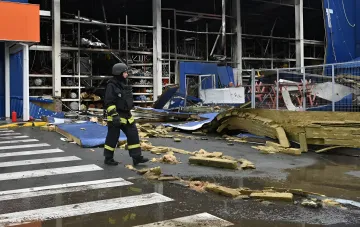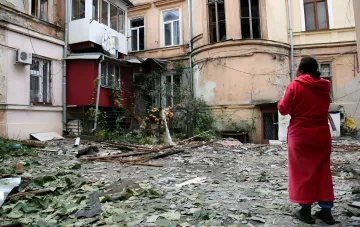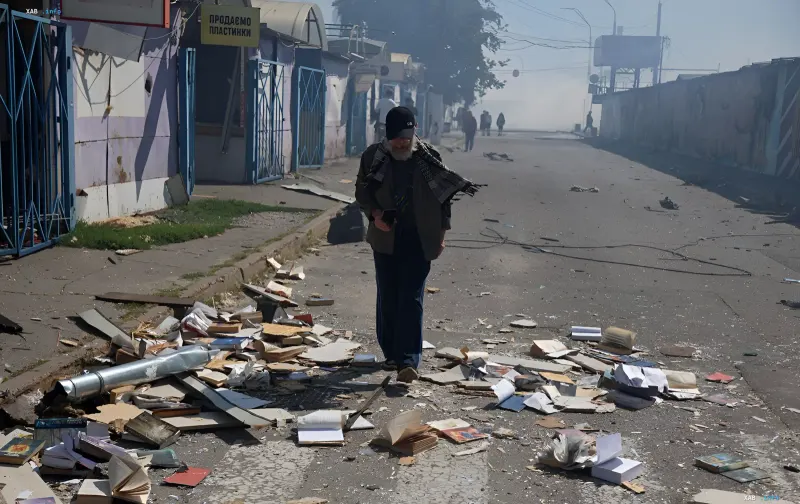
Russian shelling of printing houses and warehouses has led to the destruction of what industry estimates put at nearly half of Ukraine's annual book output. Losses may reach 15 million copies — from fiction to school textbooks. This is evidenced by an RBC-Ukraine piece, "We Will Still Fight": how publishers are protecting books from strikes and why prices are bound to rise.
Insurance Vacuum: Books Left Without Protection
The main systemic problem, according to publishing executives, is the absence of insurance for goods in stock. According to BookChef's editor-in-chief Yevhen Shyrokyn, companies insure their production capacity — the building and equipment — but not the goods in circulation. "Last year we tried to find an insurer willing to insure specifically goods in circulation, but to no avail," he admitted. The publisher "Ranok" confirmed that the state insurance program for frontline territories covers only real estate and equipment, while the books themselves are not insured. "Without insurance, there is no point in rebuilding," stated CEO Viktor Kruhlov.
Rates the Business Cannot Afford
CEO and co-founder of publisher Vivat, Yulia Orlova, pointed out that there are no state compensations, and no insurance available to the book business either. In her words, insurance companies offer terms under which the policy cost can reach 17–19% of the value of the property. "For the publishing business, such rates are economically unaffordable," Orlova noted. She emphasized that it is not only finished books that burn, but also printing materials, paper and ink, and publishers need funds for prepayments to printing houses, while printing houses need them to buy materials: the entire chain operates under conditions of extremely high risk.
Meetings With Ministries to No Avail
Recently, a number of publishers met with the relevant ministries on the issue of damage compensation. However, as Shyrokyn reported, there is still no specific mechanism of aid or compensation. Orlova added that the issue is not only a one-off compensation but also the creation of systemic tools that would allow the book business to operate and recover under conditions of constant military risk. In her words, special conditions for the book-printing sector and its systematic support are needed, since currently all losses from shelling fall on the shoulders of book publishers.
Relocation and Decentralization of Warehouses
Some publishers are trying to reduce risks by moving warehouses to western regions. However, as Shyrokyn explained, a shortage of suitable premises is already being felt: books require specific storage conditions and a certain temperature, so not any building will do. The press office of "Nash Format" noted that publishers are reassessing risks, relocating, diversifying storage locations and distributing stock across safer cities, since storing large volumes in one place is becoming more dangerous. The option of moving printed publications abroad is not being considered: according to Shyrokyn, this would double logistics, and Vivat added that importing books from abroad results in the loss of the VAT tax benefit. The publisher also reported that it is considering the decentralization of fulfillment, which "Nova Poshta" is already working on, and the need for software and professional warehouse logistics for quick order assembly from different points.
Contradictory Data
Estimates of the scale of losses vary among sources. The RBC-Ukraine piece and the headline of one of the publication's issues state that "nearly half" of the annual book output has been destroyed, with losses potentially reaching 15 million copies. Meanwhile, the business publication Delo.ua uses different wording: according to their data, in one month Russia destroyed a third of all books published by Ukraine over the year. The discrepancy may be explained by different time frames (a month versus a cumulative period) and counting methodology, however, the exact total volume of lost print runs at the time of publication has not been unambiguously recorded by any source.
What This Means for Readers
The combination of factors — the absence of insurance, unaffordable insurance rates, a shortage of warehouse space and rising logistics costs — is, according to industry estimates, bound to be reflected in book prices. Publishers emphasize that without systematic state support and a change in approaches to insurance, the recovery of the book market under conditions of military risk will be extremely difficult.