
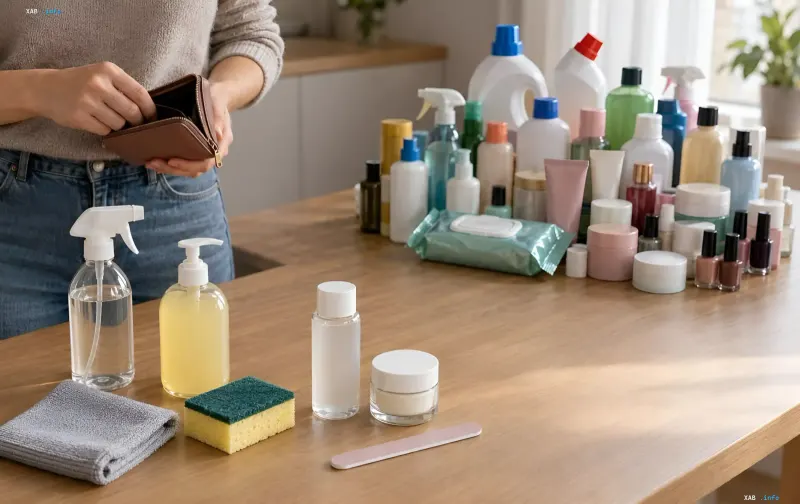
A user on Threads under the handle _khotynska_ posed a simple but eye-opening question to the audience: what purchases have you stopped making once you realized they were just "money down the drain"? The responses gathered dozens of practical examples, which Styler has grouped by theme. The overall takeaway from the discussion is this: if an item quickly bores you, wears out, or has an accessible free alternative, there's no need to keep buying it on a regular basis.
Household chemicals: from dozens of products to a basic set
Several commenters immediately mentioned household chemicals. Instead of dozens of specialized products for every surface and situation, they've kept only a few basics. "A million cleaning products. 4–5 are enough to clean an apartment properly," one participant wrote. Wet wipes for cleaning drew particular criticism: "I only ever bought one pack. It's just heavily pushed marketing. And for the environment and your wallet, it's a disaster," another noted. The logic here is simple: a minimal home kit replaces an entire shelf of narrowly specialized products.
Self-care: DIY manicures and eyebrows
The second frequently mentioned category is self-care. Some women have stopped regularly getting manicures or doing their eyebrows at a salon. "Gel polish — only nail care and a file manicure every two weeks," one participant writes. Another shared that she dyes her eyebrows herself to give the hairs a richer color, and refreshes her permanent once a year, which "saves a ton of time." Instead of a large number of body products, they've kept only the basics.
Cosmetics and "free" alternatives
People are also trying to cut back on excess cosmetics: one participant uses only a basic facial care routine prescribed by a cosmetologist. Another way to avoid overspending is not to buy things for which a free alternative already exists. "Planners. I already have everything in Google Calendar," one commenter states. In this way, digital tools are pushing paper and plastic "helpers" out of the budget.
Contradictory data
The discussion wasn't without disagreements. One participant's claim that retinol isn't needed in facial care immediately drew pushback from another user, who considers this ingredient effective for the skin. In other words, there's no consensus in the discussion on cosmetic actives: some women reduce their routine to a minimum, while others insist on keeping certain "working" ingredients. This is a clear example of how "saving money" on self-care looks different for every participant.
Wardrobe and small things: lace lingerie and trips instead of new clothes
Some have stopped regularly refreshing their wardrobe: one commenter barely buys clothes or shoes, preferring to spend money on trips. "But I can go somewhere. That's definitely better," another writes. For some, even lace lingerie became an unnecessary purchase: they used to wear it every day, but due to quick wear they've switched to more practical cotton options. The main principle of the discussion participants comes down to one thing: don't pay for things that wear out quickly, bore you, or are easily replaced by a free alternative.