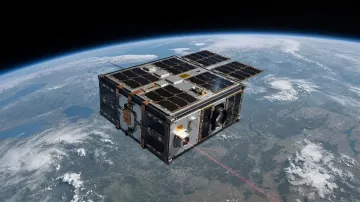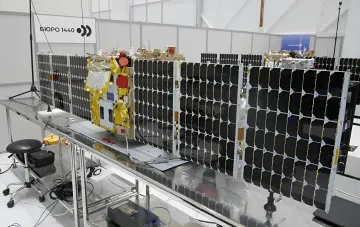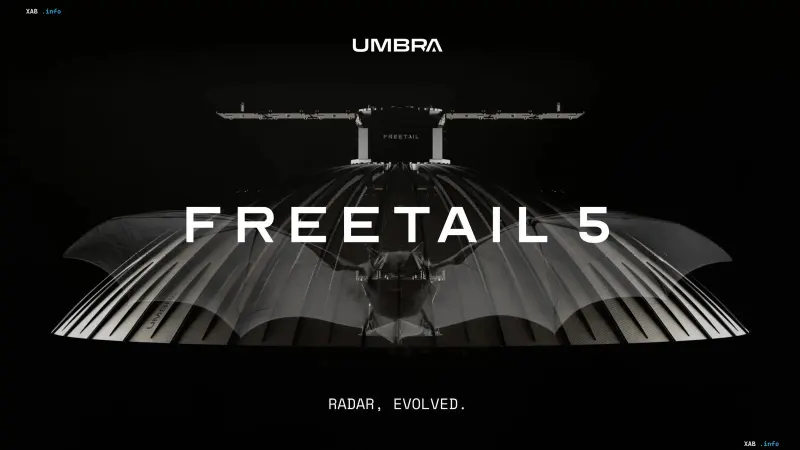
American aerospace company Umbra has announced the launch of a new generation of Earth observation satellites called Freetail. The flagship model of the series, Freetail 5 (FT-05), weighs only 200 kilograms and aims to achieve a breakthrough in the small satellite segment by providing surface detail of up to 5 centimeters. The launch of the first unit is scheduled for early 2028, with commercial availability expected by mid-year.
A Technological Leap in Radar
The core instrument of the Freetail 5 is an upgraded synthetic aperture radar (SAR) system. The spacecraft features a unique deployable mesh antenna with a diameter of 5 meters, covering a total area of approximately 20 square meters. According to the developers, this configuration surpasses the company's previous systems: the transmitter power has been increased fourfold, and the antenna's effective area has been doubled.
The system is highly efficient, capable of producing hundreds of images with 25cm resolution per day per unit, reaching a peak detail of 5cm under maximum settings. Data throughput for image processing stands at an impressive 4 GHz, enabling the rapid transmission of large volumes of data to ground stations.
Flexibility and Versatility in Orbit
One of the key features of the Freetail 5 is its software-defined architecture. Umbra emphasizes that the satellite's functionality is not static—the system's capabilities can be remotely configured and expanded after the unit reaches its target orbit. The platform supports operations in both polar and mid-inclination orbits, offering customers the ability to revisit any point on Earth every hour.
The satellite's capabilities extend beyond standard imaging. Freetail 5 can generate 3D models of terrain in a single pass, identify object coordinates via microwave signatures, conduct maritime monitoring, and track surface changes with sub-centimeter precision. Additionally, the system is designed to support satellite constellation formations for collaborative imaging.
Autonomous Manufacturing and Future Constellation
Umbra's production processes are highly localized: the company manufactures up to 90% of the spacecraft's components internally at its facility in California, utilizing its own proprietary software. This integration model allows the company to maintain quality control and manage the product lifecycle at every stage.
The significance of Freetail 5 goes beyond a single successful launch. Successful deployment of the FT-05 will form the foundation for a large-scale orbital constellation. Given the satellites' capacity to host third-party hardware and their ability to cooperate in orbit, the Umbra system could soon become a primary tool for real-time government and commercial monitoring of the planet.