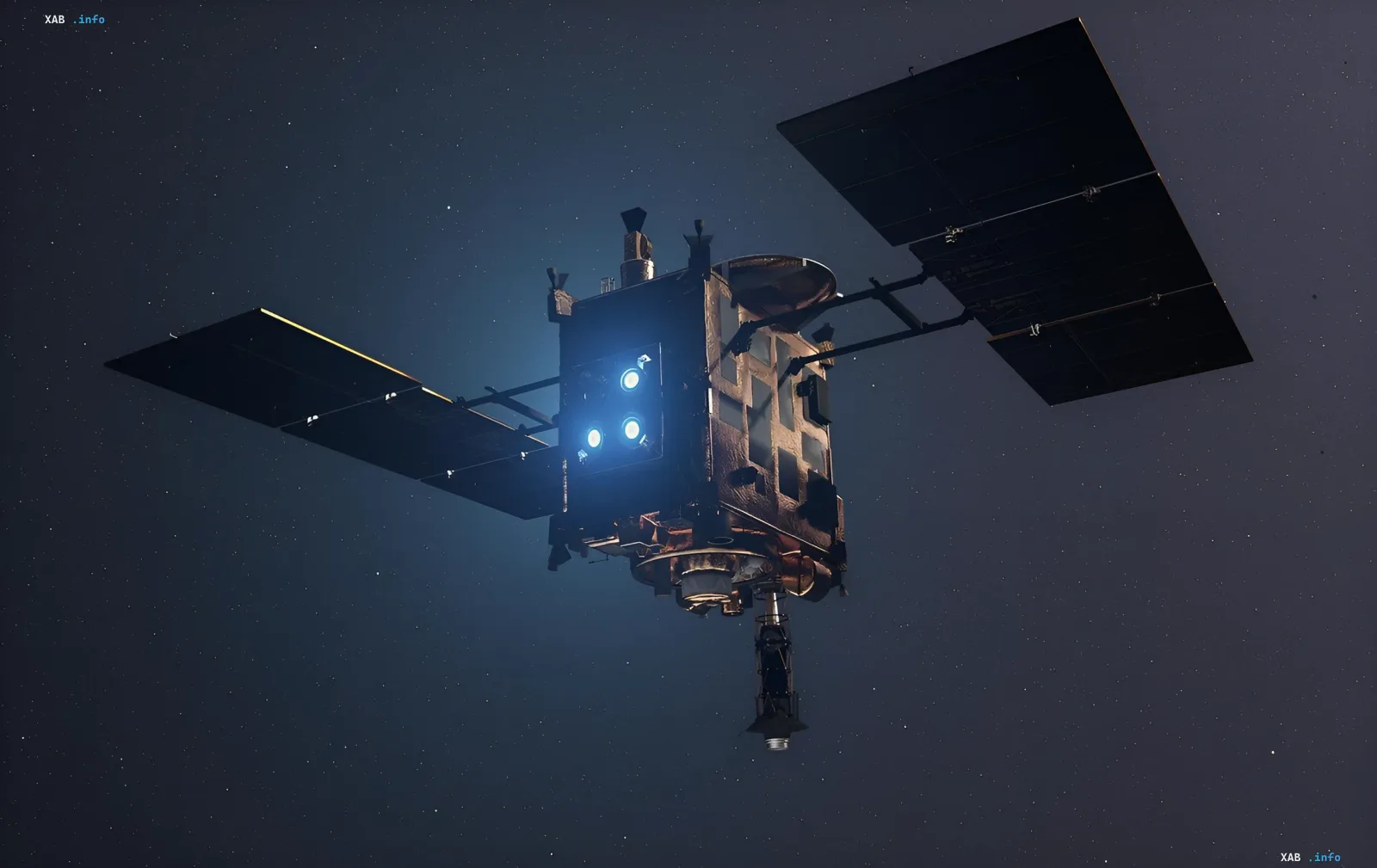
The Japanese interplanetary probe Hayabusa2, which successfully completed its historic mission to explore asteroid Ryugu, has faced a critical technical failure on its way to a new target. The spacecraft, designed to study the fast-spinning near-Earth asteroid 1998 KY26, has been left without any operational primary engines. This emergency has put the entire second phase of the ambitious space program by the Japan Aerospace Exploration Agency (JAXA) at risk.
Background and Successes of the Hayabusa2 Mission
The Hayabusa2 spacecraft was successfully launched in December 2014 with the primary goal of reaching asteroid Ryugu and gathering valuable soil samples. In June 2018, the probe safely arrived at the object, executed a unique operation to create an artificial crater using a dedicated impactor, and collected material from both the surface and subsurface layers. In December 2020, the capsule carrying the precious samples successfully landed in the Australian Outback, marking the beginning of an extended mission toward a new target, asteroid 1998 KY26, which NASA estimates contains significant water reserves.
Technical Crisis Aboard the Probe
On the journey toward its new scientific target, the propulsion system began to fail. The spacecraft is equipped with four xenon microwave discharge ion engines designated A, B, C, and D. For each engine to operate stably, two key components—the ion source and the neutralizer—must function simultaneously. Over years of flight, engines A, C, and D exhausted their operational lifespans and failed, while engine B was carefully preserved by engineers for the second stage of the mission.
However, in mid-August, the final backup engine B also shut down. Diagnostics revealed that its ion source had failed, while the neutralizer remained in working order. The situation became critical because, without main engines, continuing the flight to asteroid 1998 KY26 was impossible, leaving the mission effectively stranded in deep space.
Unconventional Rescue and Hybrid Engine Strategy
Facing an unprecedented challenge, JAXA engineers decided to employ a risky yet previously proven method. Since the failed engines C and D had broken neutralizers but functional ion sources, specialists developed a plan to reconfigure the surviving components. They intend to alter the onboard electrical circuitry and combine the healthy neutralizer of engine B with the working ion source of engine D into a single hybrid system.
The launch of this experimental hybrid setup is scheduled for late October 2026. Notably, Japanese specialists successfully applied a similar engineering trick during the first Hayabusa mission in 2010, when they managed to return the spacecraft to Earth by harvesting viable components from different failed units. Scientists hope this bold technical maneuver will save the Hayabusa2 mission and allow research to continue.