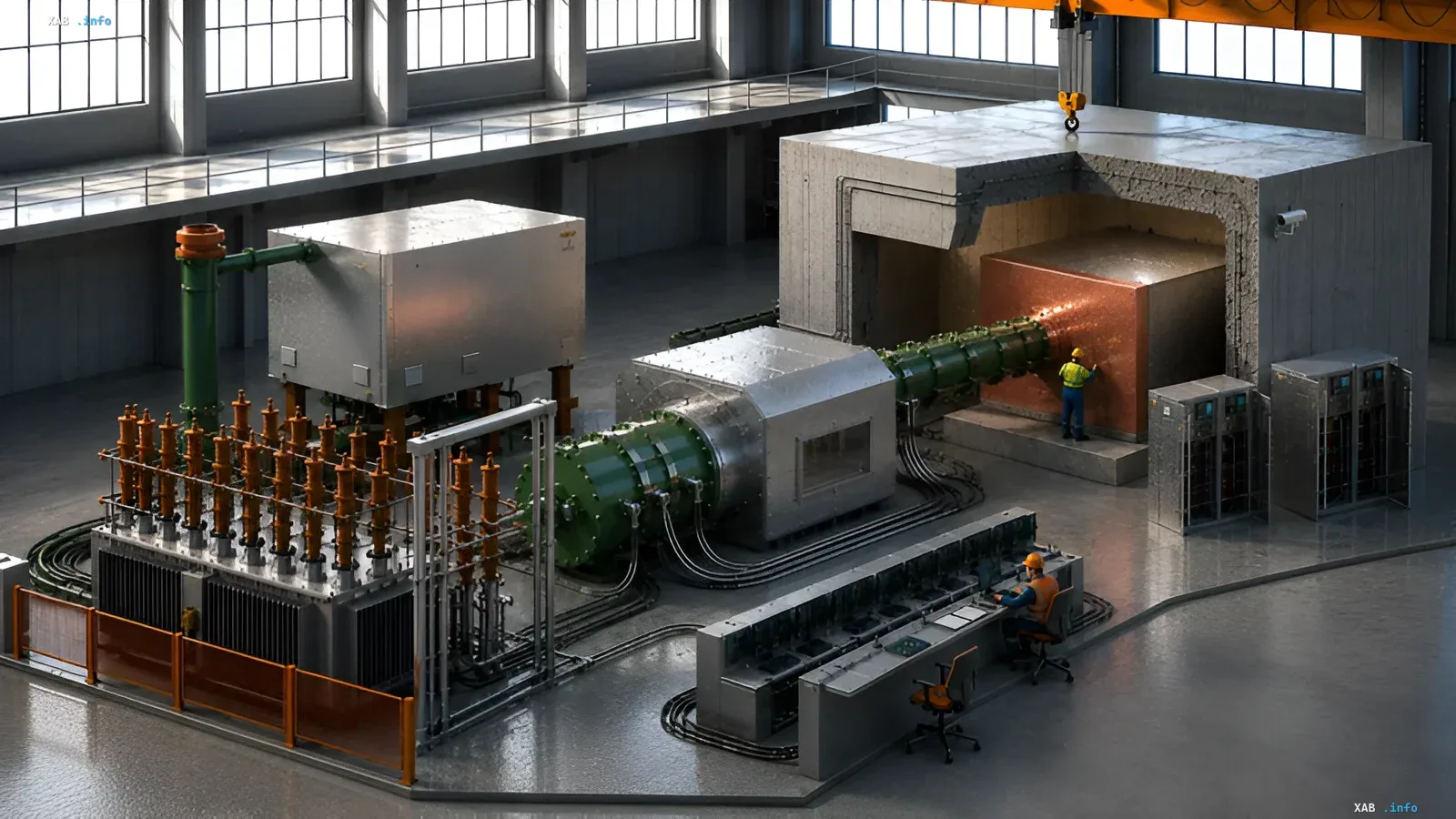
In August 2026, the fusion energy industry received a significant boost. Kyoto Fusioneering, a company specializing in the development of technologies for controlled nuclear fusion, announced the receipt of substantial grants from the U.S. Department of Energy (DOE) and the state government of Tennessee. The funding is aimed at creating and testing a prototype of a unique device called Unity-3, which is expected to be a key element in solving the problem of fueling reactors.
Unity-3: The 'Breeding Zone' in Action
The prototype development will take place in close collaboration with Oak Ridge National Laboratory (ORNL) — one of the world's leading nuclear research centers. The central element of the project is the 'breeding blanket' technology. Unlike traditional reactors that simply consume fuel, breeding blankets perform a dual function: they collect the thermal energy released during the reaction and simultaneously generate new fusion fuel, closing the cycle.
One of the most promising design options for Unity-3 involves the use of liquid lithium as the working medium. This metal plays a critical role in the process: by absorbing neutrons produced during synthesis, lithium atoms split into helium and tritium. Tritium is a heavy isotope of hydrogen and is the main component of fuel for most modern fusion reactor concepts. After being extracted from the breeding zone, tritium is sent back to the reactor, while excess heat is removed to generate electricity.
From Simulation to Real-World Testing
For a long time, the characteristics of materials for breeding zones have been studied primarily through computer modeling. The Unity-3 device will be the first step toward validating this data under real-world conditions. According to representatives of Kyoto Fusioneering, the installation will allow testing not only the properties of liquid lithium but also a range of other promising materials. To ensure stable system operation, heat-resistant materials capable of withstanding extreme temperatures, as well as special pumps and other specialized equipment, will also undergo testing.
A Domino Effect for the Entire Industry
The significance of the project goes far beyond a single company. The data obtained during the testing of Unity-3 will become a publicly available resource for the entire industry. In particular, the research results will be used by other startups, such as Realta Fusion, Thea Energy, Type One Energy, and Xcimer Energy, in designing their own reactors. This allows for reduced risks and development costs, as fundamental fuel cycle issues will be solved centrally.
A Comprehensive Approach to Fusion
Kyoto Fusioneering's work is not limited to the fuel cycle. The company is also actively developing systems for heating fusion fuel to a plasma state, technologies for recycling unburned fuel from exhaust gases, and methods for efficient heat collection for electricity generation. The creation of Unity-3 is an important step on the path to creating a fully autonomous and economically efficient fusion power plant.