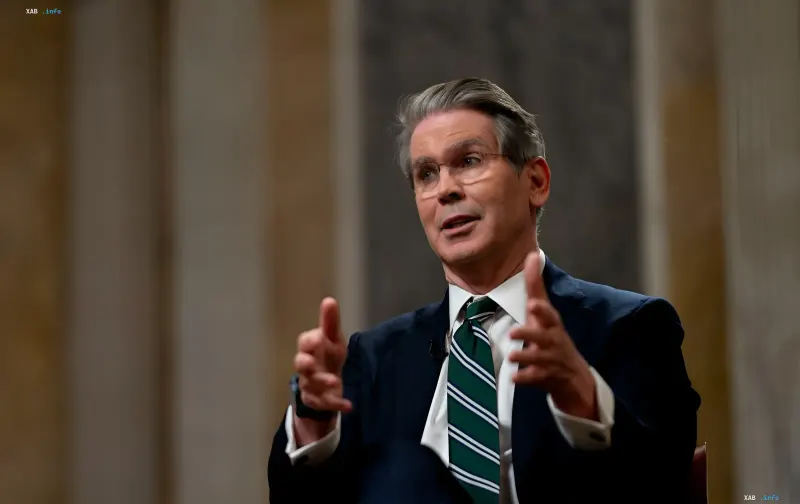
US Treasury Secretary Scott Bessent stated that Washington is preparing "the harshest sanctions in history" against Iran, which will be supplemented by an economic blockade. According to him, details of the restrictions package will be revealed at a press conference on Monday, August 24. The statement came amid escalating tensions around the Strait of Hormuz and a shift in US strategy towards Tehran — emphasizing economic pressure and strategic patience instead of direct military action.
«Double Blow»: Blockade and Record Restrictions
In an interview cited by Reuters and RBC-Ukraine, Bessent characterized the planned measures as a "double blow": "We have a blockade, and we will have the harshest sanctions in history." With this phrasing, the official emphasized that Washington intends to simultaneously cut off trade channels and intensify the financial strangulation of the Iranian economy. Analysts note that such rhetoric corresponds to a shift in the Trump administration's course, which previously considered scenarios of military strikes but is now betting on sanctions pressure and strategic patience.
Call to China and Allies
Bessent appealed to US allies and the "rest of the world" to "make a decision" and join the pressure campaign against Iran. He placed special emphasis on China, stating that China receives about 50% of its energy carriers from the Persian Gulf, meaning participation in the sanctions initiative "would be of great service to the country." At the same time, as the publication notes, a further economic war with China — the largest trading partner and exporter to the US — carries the risk of retaliatory measures from Beijing, making Washington's diplomatic calculation extremely sensitive.
Contradictory Data
There are discrepancies in figures and assessments in the statements of the parties and analytical materials. On the one hand, Bessent claims that China receives 50% of its energy carriers from the Persian Gulf. On the other hand, according to data from the analytical company Kpler for 2025, China purchases more than 80% of the oil supplied by Iran. These are different indicators (the region's share in China's imports versus China's share in Iranian exports), but in public discourse they are often mixed, creating inconsistencies in the understanding of the scale of Chinese-Iranian trade. Furthermore, there is a contradiction regarding control over the Strait of Hormuz: on August 13, Donald Trump stated that the US "totally controls" this waterway, while Iran insists that Tehran exclusively manages the key route.
Context: Strait of Hormuz and Strategy Shift
Bessent's statement came against the backdrop of a dispute over the Strait of Hormuz — one of the world's most important oil transportation routes. Bessent emphasized that "everyone wants the Strait of Hormuz to be open again, and energy prices to fall," which indirectly points to current disruptions or threats to shipping in the region. It was previously reported that Trump changed his strategy towards Iran, betting on sanctions and patience instead of military action, and announced the application of "unprecedented measures" of economic pressure on the regime.
Historical Background: Almost 50 Years Under Sanctions
As RBC-Ukraine reminds, Iran has withstood harsh economic sanctions for almost 50 years — since the time of the Islamic Revolution of 1979. This means that the Iranian economy is already adapted to long-term external pressure, and the new package of restrictions, according to Bessent, must be qualitatively stricter to achieve a change in Tehran's behavior. The success of the initiative will largely depend on whether key trade partners of Iran, primarily China, join the pressure.