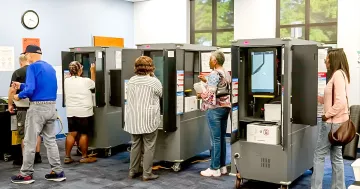
According to preliminary projections by major U.S. television networks and news agencies, the November 3, 2026, U.S. midterm congressional elections are tilting in favor of the Democratic Party. As reported by RBC-Ukraine citing projections from AP, CNN, NBC News, CBS News, and CNBC, Democrats have flipped Senate seats from North and South Carolina and are projected to reclaim a majority in the House of Representatives. All data cited below is preliminary: final vote totals will be certified by the states later, and vote counting is still ongoing in several key races.
Senate: Democrats Reach the Halfway Mark to Majority
Before the elections, Republicans held 53 seats in the Senate compared to 47 for Democrats. To secure a majority, Democrats need a net gain of four seats without losing any of their own. As of the publication of these projections, they have already traveled half that distance. In North Carolina, former Democratic Governor Roy Cooper defeated Donald Trump-backed Republican Michael Whatley. Cooper will take the seat of retiring Republican Senator Thom Tillis. Notably, Democrats had not won a Senate election in this state since 2008.
South Carolina and Georgia: Victories in Traditionally 'Red' States
An even more stunning victory occurred in South Carolina, where Donald Trump won by nearly 18 points in the 2024 election. Democrat Annie Andrews defeated Republican Darlin Graham, who was temporarily filling the seat of the late Lindsey Graham. Andrews will become the first woman elected to the Senate from the state; a Democrat last won a Senate election here in 1998. Democrats are holding their own seats as well: CNN called Georgia for Senator Jon Ossoff—also won by Trump in 2024—and AP projected a Democratic win in New Hampshire. The remainder of the path to a majority will be decided by seven key states: Iowa, Alaska, Kansas, Maine, Michigan, Ohio, and Texas. According to CNBC and NBC estimates, races in Texas, Ohio, and Kansas are leaning toward Democrats, while Michigan remains their primary defense vulnerability. Winners in these states have not yet been called.
House of Representatives: The Fight for 218 Seats
All 435 seats are up for election in the House of Representatives, with 218 needed for a majority. Republicans held a razor-thin advantage, meaning Democrats needed a net gain of just three seats. According to CNBC projections, they will win the lower chamber's majority. CNN data shows Democrats have flipped at least five Republican-held districts, including North Carolina's 11th District—where Trump won by 10 points in 2024—and Kentucky's 6th District, where his margin was 15 points. Furthermore, Democrats defended three seats in Florida that Republicans had redrawn to capture. If these projections hold, Republicans will lose control of both chambers of Congress.
Governors' Races and First Results from Guam
In gubernatorial races, Democrats are holding their ground as expected: CNN called wins for Josh Shapiro in Pennsylvania—won by Trump in 2024—and J.B. Pritzker in Illinois, who became the first Democrat elected governor of the state three times. The very first preliminary results nationwide came from the U.S. territory of Guam, where, due to its proximity to the International Date Line, voting ends earliest: according to the local election commission, Republicans are reclaiming the island's governorship, while Alicia Ann Garrido Limtiaco won the non-voting House delegate seat for the Democrats. Donald Trump promptly commented on these results, calling them a harbinger of success for his camp.
Voter Sentiment and Caveats
Ahead of and on Election Day, voter sentiment did not favor the incumbent president. According to preliminary CNN exit polling, about 60% of Americans disapprove of Trump's job performance, roughly three-quarters view the country's situation negatively, and nearly four in ten report feeling angry; other polls peg the president's approval rating at around 32% and show Democrats leading in several key races. It is important to emphasize that all figures cited are media projections and preliminary count results: Alaska, Iowa, and Kansas have little or no results yet, and final outcomes will be officially certified by the states at a later date.