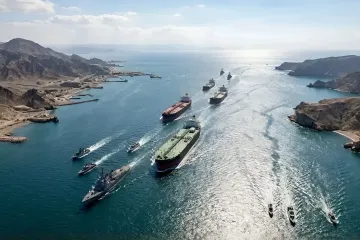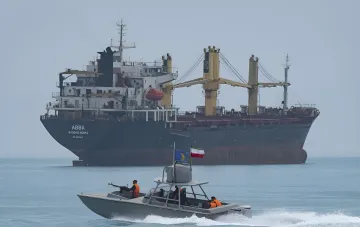
The United States Central Command (CENTCOM) reported that American forces "took limited and precise measures" against units of the Islamic Revolutionary Guard Corps (IRGC) that, according to Washington, were laying naval mines and posing a threat to shipping in the Strait of Hormuz. This was stated by the command itself in a post on the social network X, as reported by RBC-Ukraine. The statement emphasized that the strikes were aimed at protecting civilian sailors, commercial shipping, and the "free flow of global trade."
Nature of the strikes and CENTCOM's position
The American command formulated its position in sharp terms: "Essentially, Iran created this threat, and American forces eliminated it to protect civilian sailors, commercial shipping, and the free flow of global trade." Thus, Washington emphasizes the defensive and "pinpoint" nature of the operations, subordinating them to the task of ensuring the security of one of the world's key oil arteries. A number of international media outlets, including DW and BBC, confirmed that this is the first such US strike on Iran in over a month.
Iran's response and escalation of the conflict
On Sunday, American forces struck the Iranian island of Larak near the Strait of Hormuz for the first time in over a month. Following this, according to available data, Iran moved to retaliatory action and attacked American military facilities in Jordan. Tehran, in turn, characterized the US strikes as an "act of aggression." US military called this statement false, rejecting the characterization of their actions as aggressive.
Economic pressure and China's position
Meanwhile, according to Bloomberg, global markets are largely ignoring the new US threats and continue to trade with Iran. Washington's attempt to carry out a so-called "economic offensive" proved, according to the publication's assessment, ineffective: a key role in this was played by China's position and the unwillingness of a number of allies to sever trade ties with Tehran. This limits the pressure levers available to the US administration within the sanctions and economic framework.
Qatar's negotiations and the question of unblocking the strait
On the diplomatic track, Qatar is negotiating with Iran on the unblocking of the Strait of Hormuz. According to available information, Tehran agreed to draw up a list of conditions for restoring normal vessel traffic. However, as Bloomberg notes, the strait is likely still mined, despite US President Donald Trump's statements about its complete clearance. This situation indicates that the issue of shipping security in the strait remains open and unresolved.
Contradictory data
The provided sources and statements by the parties record at least two inconsistencies. The first concerns the state of the Strait of Hormuz: on the one hand, Trump claimed the strait had been fully cleared of mines, while on the other — Bloomberg reports that the strait is likely still mined. The second inconsistency relates to the characterization of the strikes themselves: CENTCOM describes them as "limited and precise measures" to eliminate a threat created by Iran, while the IRGC and Tehran call them an "act of aggression," and the American command in turn calls the Iranian version false. Both versions are presented in the text without preference for either.