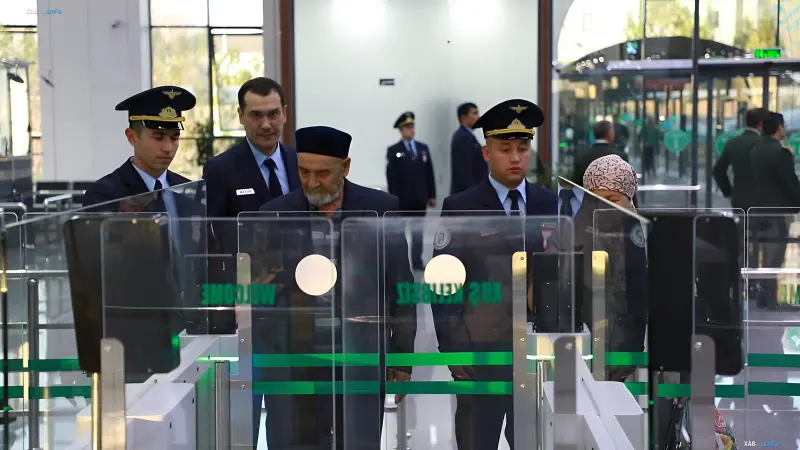
On November 25, 2026, on the Kazakhstan-Uzbekistan border, following nearly two years of reconstruction, one of Central Asia's busiest border checkpoints resumed operations — Gishtkuprik on the Uzbek side and Zhibek Zholy on the Kazakh side. The opening ceremony was attended by Kazakhstan's Finance Minister Madi Takiyev and Uzbekistan's Deputy Prime Minister and Minister of Economy and Finance Jamshid Kuchkarov. The crossing is located near Tashkent and connects it with the southern Kazakh city of Shymkent, meaning its closure during modernization caused significant inconvenience for passengers and businesses.
Scale of renovation on both sides of the border
The reconstruction affected infrastructure on both sides. On the Uzbek side, the facility's territory was expanded from six to nine hectares, the number of pedestrian lanes doubled from four to eight, vehicle inspection lanes increased from four to 18, and parking capacity expanded from 20 to 200 cars. On the Kazakh side, two new passenger terminals with a total area of about 10,000 square meters were built, separating arriving and departing flows; they house 82 passport control counters and 20 automated gates, while a general canopy covering about 6,000 square meters was equipped for vehicle inspections.
Technologies and new capacity
According to Iroda Isokova, senior inspector at the Customs Committee of Uzbekistan, the checkpoint has introduced X-ray scanners, body scanners, radiation detection systems, and modern video surveillance equipment. She highlighted the Smart Customs Border system as a key innovation designed to optimize customs procedures and reduce waiting times. The modernized crossing is designed to serve 70,000 travelers per day, and up to 100,000 during peak periods; for transport, the standard is up to 3,000 passenger cars and 400 buses daily. For comparison, in 2024 more than 11 million passengers passed through this section of the border, averaging about 30,000 people per day.
Impact on freight traffic and neighboring crossings
Although the reopened checkpoint serves pedestrians, cars, and buses rather than trucks, its opening will indirectly relieve the freight corridor as well. During the reconstruction, passenger transport was redirected to the neighboring Navoi checkpoint, which was originally designed for freight traffic, resulting in temporary restrictions on trucks there. According to the Customs Committee of Uzbekistan, the operation of Gishtkuprik will restore freight traffic through Navoi and ease the burden on other border crossings. Askarjon Makhmudov, deputy chairman of the Uzbek Cultural Association in the Saryagash district of Kazakhstan, noted that previously crossing the border by car took anywhere from three to four hours to 12 hours, and sometimes the whole night.
Context: tourism, trade, and the «Middle Corridor»
The resumption of the crossing coincides with the growth of trade and tourism ties between Central Asia's two largest economies. In the first ten months of 2026, Uzbekistan welcomed over 11.6 million foreign tourists — up 19.4% from the previous year; Kazakhstan became the second-largest source of arrivals with over 2.7 million visits, while inflows from Germany and the UK grew by 26% each, and from France by 20%. Bilateral trade over the same period reached $4.4 billion (about €4 billion), increasing by 20%, and both countries intend to bring its volume to $10 billion by 2030. At the regional level, on November 16 in Brussels, representatives from the EU, Central Asia, the South Caucasus, and the Black Sea region discussed cooperation in transport, energy, and digital infrastructure; one of the European Commission's priorities remains the development of the «Middle Corridor», through which trade volume is planned to triple and transit times reduced by 2030.