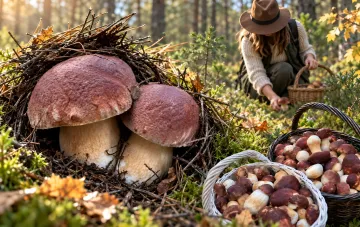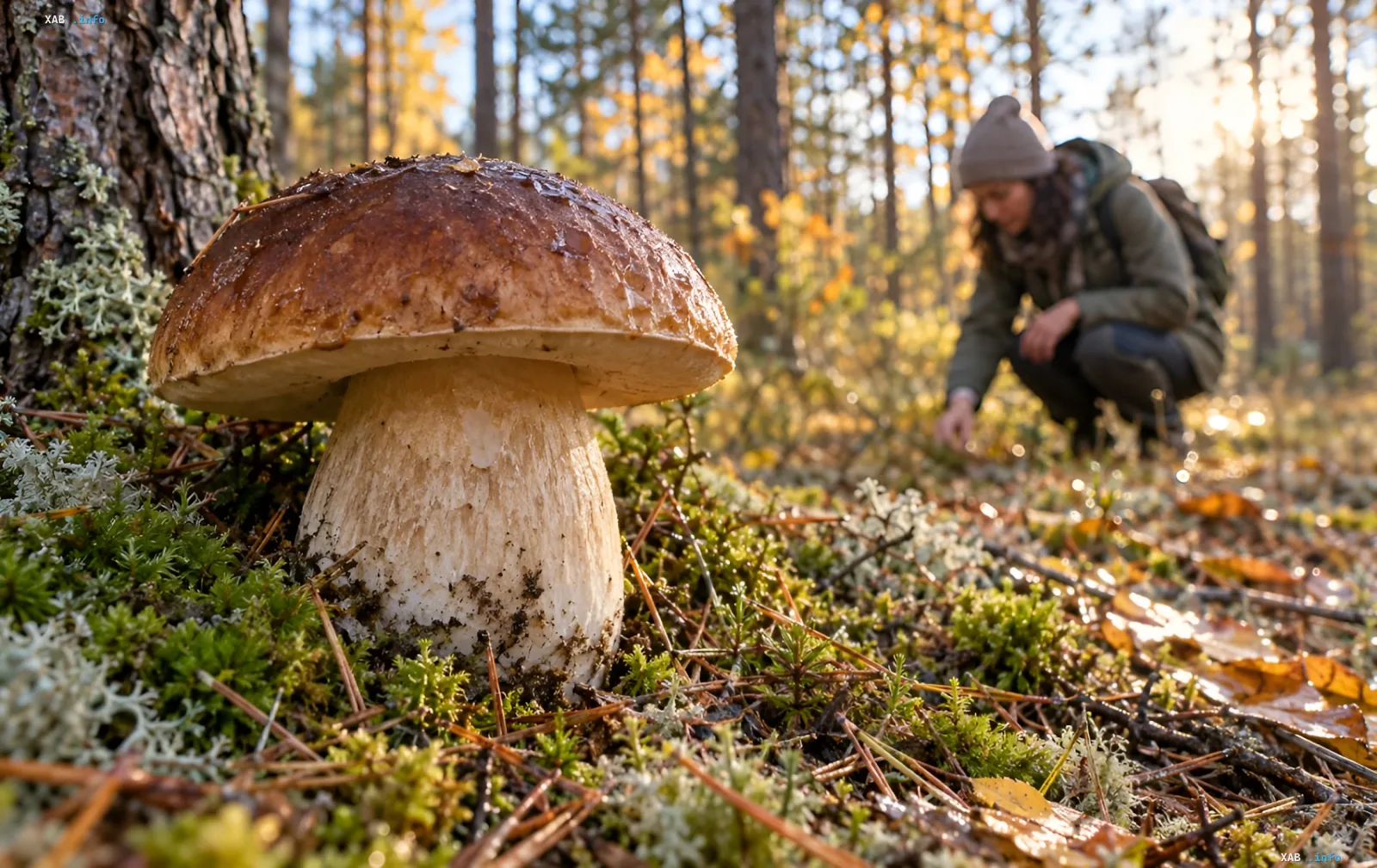
October does not mean the mushroom season is over, as deep into autumn after rains the forests still offer great conditions for harvesting porcini, slippery jacks, aspen boletes, chanterelles, and milk caps. The main secret of a successful quiet hunt during this period is the ability to read the forest ecosystem and navigate by companion vegetation. Experienced mushroom pickers know that most valuable forest fungi form a symbiotic relationship with plant roots known as mycorrhiza. Therefore, searching for specific mushroom species directly depends on which tree species dominate a chosen forest area.
Tree Landmarks: From Birches to Coniferous Forests
If the forest is rich in birches, special attention should be paid to the area directly beneath them and within a radius of several meters. The common rough-stem bolete has a strong biological connection to birch groves and can bear fruit right up until frost. Furthermore, birches serve as an excellent landmark for finding porcini mushrooms, which readily inhabit not only spruce or pine forests but also mixed and deciduous woods. In turn, young and middle-aged pine forests are ideal for finding slippery jacks. The common slippery jack forms a stable mycorrhiza with conifers, preferring sunny edges, forest clearings, and young plantings where its bright oily caps stand out clearly against the ground.
The Role of Moss and Associated Natural Indicators
Many mushroom enthusiasts traditionally consider moss to be the main indicator of fungal hotspots, but experts urge a balanced approach to this factor. Dense moss on sandy soils under pines certainly creates a favorable microenvironment, but by itself it does not guarantee a harvest underneath. Rather, moss acts as part of a complex landscape that must be evaluated in combination with soil type, moisture, and sunlight exposure. Additional interesting landmarks for pickers often include toadstools. Specifically, the fly agaric often grows alongside porcini in coniferous forests due to similar environmental requirements, turning into a visual beacon for finding noble boletes.
Weather Influence and Temperature Regimes on October Harvesting
October weather conditions play a key role in the duration of the mushroom wave. As long as night temperatures remain relatively warm, the season continues successfully, delighting lovers of delicate mushrooms with abundant fruiting. However, the first steady frosts can sharply reduce the population of heat-loving species, leaving chances only for the most cold-resistant forest gifts. That is why before heading into the October forest, it is important to carefully study the weather forecast and choose areas warmed by daytime sun.
Contradictory Data
In expert circles and among mushroom pickers, there are certain disagreements regarding how reliable indicators forest companions like moss or toadstools actually are. On one hand, authoritative mycological databases and studies note a direct correlation between the presence of certain trees (birch, pine, spruce) and the appearance of mycorrhizal fungi such as porcini and slippery jacks. On the other hand, folk omens often exaggerate the importance of the moss cover as a direct pointer to specific species, although science views moss only as an indirect sign of a suitable type of acidic and well-drained soils.