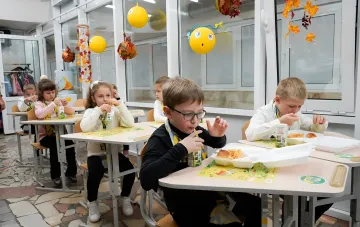
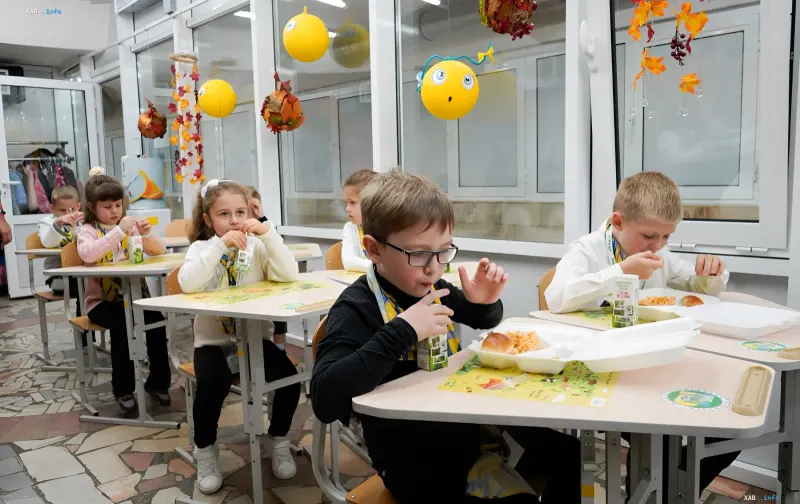
School catering in Ukraine is not an improvisation, nor is it an arbitrary choice of dishes based on the cook's mood. Behind what ends up on a student's plate is a multi-level system of planning, coordination, and control that begins long before the first school bell. The basis for this article: from September 1, 2026, all students of communal schools studying in a full-time or blended format will receive free hot meals funded by the state at a rate of 50 hryvnias per day for primary school and 60 hryvnias for students of basic and specialized secondary education. It is in this context that the question of who and how the menu is compiled becomes particularly relevant for millions of families.
The Four-Week Cycle: The Foundation of the School Diet
To organize catering in educational institutions, a sample four-week seasonal menu is used. On its basis, a daily menu schedule is compiled — a specific plan of what children will eat each day. This approach allows the diet to be planned in advance for an extended period, to comply with established sanitary nutrition standards, to take into account the seasonality of available products, and to ensure a variety of dishes so that children do not receive the same food day after day. It is on the basis of this sample seasonal menu and technological documentation that the daily menu schedule is subsequently formed, and it is according to this schedule that the canteen operates.
Who Develops the Menu: The School or the Supplier
The answer to the question of who exactly creates the menu depends on the catering organization model in a particular school. If the institution independently prepares and serves ready-made dishes, the menu is developed directly within the school with the involvement of relevant specialists. If catering is provided by a supplier enterprise, the menu is developed by that enterprise, and the school approves the proposed version when concluding the relevant agreements. Regardless of who is the author of the menu, the final approval always rests with the head of the educational institution: if the school developed the menu, the director approves it; if an external supplier proposed it, the head first coordinates and then approves it.
The Role of the State Service for Food Safety and Consumer Protection and Exceptions to the Rule
After internal approval at the school, the sample four-week seasonal menu must be coordinated with the territorial body of the State Service of Ukraine on Food Safety and Consumer Protection. It is precisely the sample seasonal menu, and not the daily schedule, that is submitted for coordination. At the same time, the State Service does not coordinate technological cards for dishes and products, however, it recommends submitting them together with the menu so that specialists can verify the compliance of the provided dishes with established requirements without additional clarifications. An important exception: if the school uses a menu recommended by the Ministry of Health, additional coordination with the State Service is not required. In the event that the menu is not coordinated, this does not mean a formal correction of documents, but rather the need for further work: to take the remarks into account, make changes, and resubmit the menu to the territorial body of the service.
Substitutions, Control, and Children's Special Needs
In the course of operations, situations may arise at the school where a particular product or dish needs to be substituted. This cannot be done arbitrarily: the substitution must comply with established requirements and ensure the proper nutritional value of the diet, and temporary changes must not turn into a persistent non-compliance with the approved menu. Control over compliance with the four-week seasonal menu and the daily menu schedule is entrusted to a responsible person designated by the head of the institution. The planned dishes and what was actually prepared and served to children must strictly correspond to the menu schedule. Separately, when organizing catering, the special dietary needs of children are taken into account: for such students, catering is organized in accordance with their needs and established requirements, and information about children requiring special nutrition must be taken into account when organizing the institution's operations.
The Menu Is Only One Element of the Safety System
An approved menu is only one of the elements of the overall school catering system. In addition to a correctly compiled and coordinated plan, the school must ensure the quality and safety of products, proper storage, compliance with cooking technology, the required portion yield, and the timely serving of ready-made dishes in accordance with the menu schedule. Only the combination of all these factors guarantees that the free hot meals, which all students of communal schools will receive from September 2026, will be not just a formal line item in the budget, but a full-fledged, balanced, and safe diet for a growing child's body.