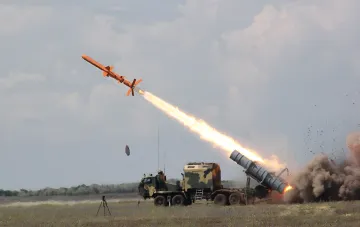
A recent publication by The Wall Street Journal on the state of the Ukrainian defense industry, released against the backdrop of successful strikes on the Kerch Bridge using Neptune missiles and Palianytsia rocket-drones, has identified what aviation expert and defense enterprise development director Anatolii Khrapchynskyi calls a "dangerous cognitive trap." American journalists state: the Ukrainian defense industry has hit a scaling ceiling. While the Luch Design Bureau is capable of producing more than a thousand Palianytsias per year, the count for heavy cruise missiles is in the hundreds — fewer than what Russia is churning out. The same material includes a diagnosis from American military consultants: the problem is that Ukraine has spread limited funds across more than 1,300 companies, allowing commanders to order equipment directly and rely on donations. According to this logic, a swarm of small players burns through resources that could have been directed toward large-scale series.
Two Non-Intersecting Circuits
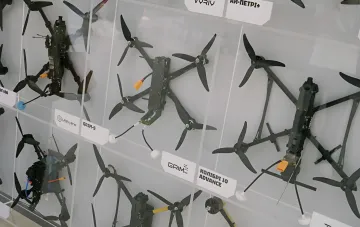
Khrapchynskyi argues that the American criticism is based on a fundamental misunderstanding of the financing architecture of the Ukrainian Defense Forces. A Western advisor views the Ukrainian market through the prism of the 1993 Pentagon reform known as the "Last Supper," when the US Secretary of Defense effectively forced dozens of aviation and missile companies to merge into five giant prime corporations. In this logic, everything is clear: the state issues a long-term contract to one giant, and it builds the supply chain itself. However, under wartime conditions in Ukraine, two separate circuits that do not intersect in terms of budget are operating—out of necessity and, according to the expert, with complete justification. The first is the heavy, capital-intensive strategic industry: cruise missiles, long-range strike systems, artillery, armored vehicles, and radar. This involves closed government contracts from the Defense Procurement Agency, special fund resources, and external financing under the so-called "Danish model." The second circuit consists of decentralized tactical-level procurements, where a brigade uses its own funds or the DOT-Chain system to order a specific FPV-drone modification, a ground robotic complex, or trench electronic warfare equipment from a small engineering team. According to Khrapchynskyi, this is not "budget fragmentation," but a matter of the infantryman's physical survival at a specific point on the front line.
Real Scaling Barriers
The true reasons why the Ukrainian defense industry cannot endlessly increase volumes lie in a different plane. First, the gap between production capacity and the Ministry of Defense's solvent demand: factories are capable of producing more than the agency is able and willing to purchase in the current budget cycle. Second, the need to disperse production due to constant combined missile and drone strikes, which physically limits the concentration of assets in one place. Third, the staffing shortage, which cannot be solved in two years by simply rewriting budget lines. Khrapchynskyi emphasizes: the development of the Neptune missile started back in 2010, and the first real money for mass production only arrived at the end of 2020. A decade of chronic underfunding of the missile program and the loss of closed production cycles in the 1990s and 2000s—from special chemistry and gunpowder to domestic microwave microelectronics—cannot be replenished in a short time.
Entering the West as a Strategy, Not an Escape
A separate point of the column concerns the expansion of Ukrainian defense companies into Western markets. Khrapchynskyi insists that this is a rational way to attract capital and protect research and serial production lines, not a "flight from the country." In conditions where internal solvent demand is limited by one state's budget, entering European markets allows for the diversification of funding and keeps engineering competencies in a functional state.
What Instead of 'Market Cleansing'
Instead of forced centralization along American lines, which, according to the author, would only reduce the speed of adaptation, Khrapchynskyi suggests a set of concrete measures: the introduction of unified technical standards and open architecture, joint procurement and production with European partners, and the formation of a state pool of critical components that should not depend on a single supplier. According to him, it is precisely this model that allows for maintaining the decentralized flexibility of the tactical level while simultaneously building up strategic-level serial capacities.
The column was published in RBC-Ukraine and represents an expert analysis rather than the official position of any government agency. Nevertheless, it captures the growing divergence between the simplified consulting narratives promoted in Western media and the engineering-economic reality of Ukrainian defense production under active war conditions.