Towel hooks, soap dishes, and suction shelves can hold firmly onto ceramic tiles for months, only to suddenly fall off and drop everything hanging from them. Intuitively, it seems the reason lies in cheap mounting quality, but in reality, durability is affected by several factors at once: the texture and condition of the tile surface, the microclimate in the bathroom, and, importantly, correct installation. We break down what physically holds a fastener to the wall and why this hold deteriorates over time.
The Physics of Suction Cups: It Is All About Pressure Difference
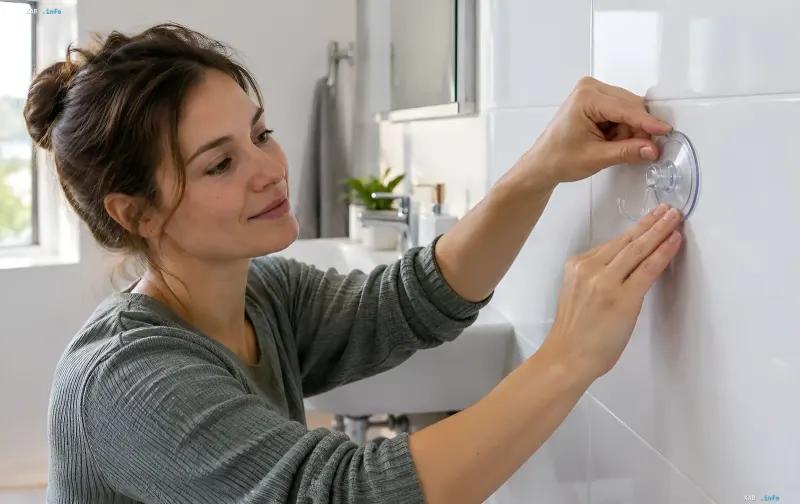
A suction cup holds onto tiles not because it "sticks", but due to the difference in atmospheric pressure. When you press the elastic base against the wall, some of the air is forced out from under it, and external atmospheric pressure holds the mount to the surface. The problem is that over time, air gradually seeps under the edges of the suction cup, airtightness is compromised, and the mount loses its hold. A study published in the journal Soft Matter confirms that the duration of such a hold depends on surface roughness, as well as the stiffness and elasticity of the suction cup material itself.
Why the Adhesion of Self-Adhesive Hooks Weakens
Self-adhesive hooks work on a different principle — through adhesion, meaning the bonding of the adhesive layer to the tile surface. This comes with its own vulnerability: if a hook is glued right after taking a shower, a thin layer of condensation remains on the wall, preventing the glue from making proper contact with the surface. Furthermore, ordinary adhesive strips are not always designed for regular water contact, high humidity, and temperature fluctuations, causing adhesion to degrade faster.
Typical Installation Mistakes
One of the most common mistakes is hanging a towel immediately after installing the hook. The adhesive needs time to form a strong bond: for example, fastener manufacturer 3M Command recommends waiting at least an hour before applying any load for many of its models. The second mistake is installation on an unprepared surface: limescale, soap scum, and detergent residue create a barrier between the adhesive (or suction cup) and the tile.
How to Properly Prepare the Surface and Choose a Mount
Before installation, the tiles must be thoroughly cleaned of scale and dirt, detergent residue washed away, and the surface wiped completely dry. The suction cup itself should also be washed with warm water and checked for cracks or deformations at the edges. It is best to press the suction cup from the center to the edges to push out as much air as possible, choosing the smoothest section of tile without grout lines or decorative elements. For self-adhesive hooks, you should choose waterproof fasteners specifically designed for bathrooms and follow the manufacturer's installation times and weight limits.
Micro-Texture, Alternatives, and Myths About Oil
Matte tiles are not necessarily unsuitable for suction cups: the decisive factor is not gloss, but smoothness. If the tile has a micro-texture, you can use special smooth self-adhesive mounting disks onto which the suction cup is placed — they create a flat contact surface. Alternatives include vacuum mounts with a locking mechanism, waterproof self-adhesive holders, or hanging organizers that do not require gluing to the wall at all. At the same time, the popular advice to grease the edges of suction cups with oil, petroleum jelly, or hand cream is more harmful than helpful: such agents promote slipping, accumulate dirt, and may be incompatible with the suction cup material. If a mount regularly falls off even after proper surface cleaning, it is better to replace it rather than trying to restore airtightness with makeshift means.