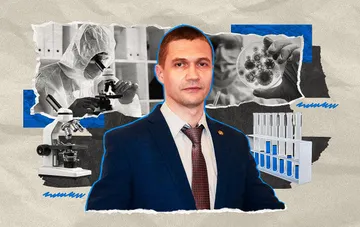
Back in 2021, Ukrainian scientists developed a unique prototype of a domestic COVID-19 vaccine based on yeast, which showed 93% neutralizing activity during laboratory tests on animals. Despite promising results and the simplicity of potential manufacturing, the project was completely shut down by the end of that year. Kostyantyn Dmytruk, Director of the Cell Biology and Genetics Institute of the National Academy of Sciences of Ukraine, explained the reasons for stopping this large-scale scientific work and the prospects of the biopharmaceutical sector.
Innovative Technology Based on Yeast Cells
To create the experimental drug, researchers used Komagataella phaffii yeast. On the surface of these single-celled organisms, scientists placed a key fragment of the SARS-CoV-2 spike protein, which is directly responsible for infection penetration into human cells. After thermal heating and inactivation of the yeast cells, the preparation acquired a form fully suitable for oral application in the form of drops or tablets.
The main technological advantage of this approach was the relative ease of scaling production. Unlike complex mRNA vaccines requiring ultra-cold supply chains, the yeast analogue did not need expensive and specific storage and transportation conditions. This opened up prospects for efficient logistics even in remote or crisis-affected regions.
Clinical Barriers and the Financial Factor
During the preclinical stage, the prototype was tested on laboratory mice. Blood serum analysis of the immunized rodents recorded the production of specific antibodies with high neutralizing activity at the 93% level. However, successful tests on animals only confirm safety and immunogenicity at the initial stage, but do not guarantee a similar result for the human body.
Reaching the stage of clinical trials involving humans required colossal financial investments that the institute did not possess. As Kostyantyn Dmytruk explained, drug development requires huge investments with a high risk of failure. By the time the project was completed, globally approved and accessible international vaccines had already appeared on the market, making further financing of the domestic development economically unviable.
Prospects of the Veterinary Direction and Market Realities
Over the years of independence, the Ukrainian scientific base has not brought a single independently developed vaccine for humans to the market. High competition from global pharmaceutical giants and heavily regulated registration processes create insurmountable barriers for local projects without state venture-type support.
As a more realistic alternative, scientists propose reorienting similar developments toward veterinary medicine. Creating vaccines for animals is characterized by simpler approval procedures, lower time and financial costs, and steady demand from domestic agribusiness. According to experts, it is in the veterinary sector that Ukrainian scientific developments can most quickly find practical application and commercial success.