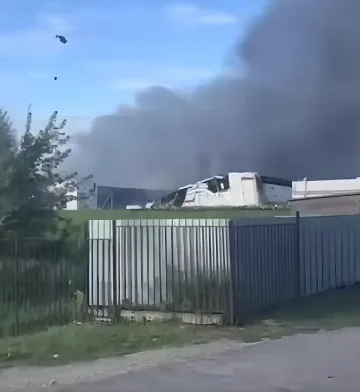
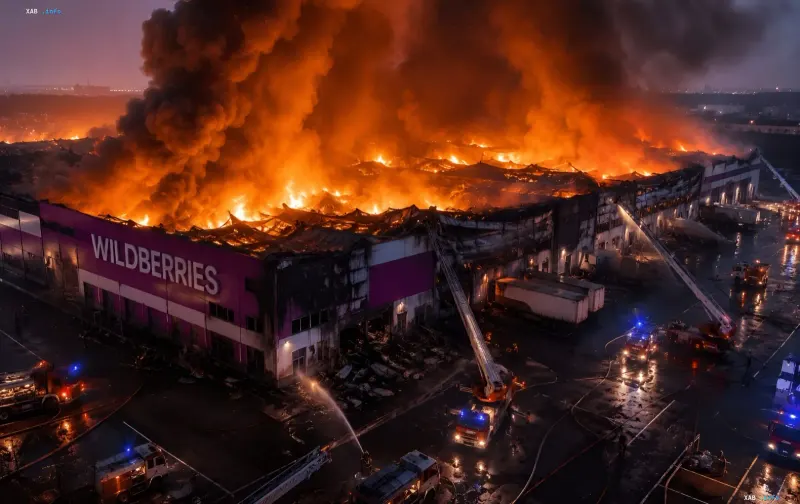
On August 13, 2026, Russia's largest marketplace, Wildberries, faced an unprecedented crisis. Large-scale attacks on the company's logistics infrastructure led to colossal financial losses and the actual destruction of a significant portion of its warehousing capacity. According to analysts, the damage amounts to billions of dollars, threatening the stability not only of the business itself but also of hundreds of thousands of sellers dependent on the platform.
Catastrophic losses of warehouse infrastructure
The situation at Wildberries warehouses is assessed by experts as critical. According to the latest data from the analytical agency Data Insight, at least 12 major warehouse complexes have been virtually completely destroyed as a result of a series of unmanned aerial vehicle (UAV) strikes. Sergey Semko, an expert at Data Insight, stated in an interview with The New York Times that the company has "practically no large warehouses left."
Warehouse space losses are estimated at approximately one-third of the marketplace's total capacity. This puts the business's operational activities at risk, which previously demonstrated aggressive growth. Wildberries' annual sales volume is estimated at $74 billion, and its network of pickup points includes nearly 100,000 locations across the country.
Scale of damage: comparison with regional budgets
The financial consequences of the attacks go far beyond corporate reporting. To date, the company's direct losses due to the destruction of goods and infrastructure amount to about $6 billion. To understand the scale of this figure, it is sufficient to compare it with the budgets of Russian regions.
The damage amount is equivalent to the annual budget of the Krasnoyarsk Krai. Wildberries' losses are approximately 1.6 times higher than the annual budget of the Irkutsk region. For less wealthy regions, such as Smolensk or Penza Oblasts, this amount is almost four times their annual budget. In the case of Kalmykia, the Jewish Autonomous Oblast, or the Nenets Autonomous Okrug, the marketplace's losses exceed their budgets by 14–17 times.
Blow to sellers and the Russian budget
The destruction of warehouses has dealt a blow not only to the platform owners but also to hundreds of thousands of sellers whose products were stored in the destroyed complexes. A source close to the Kremlin told Reuters that the Russian budget currently does not have the hundreds of billions of rubles necessary to fully assist the affected sellers and compensate for losses.
The country's financial situation is further pressured by war expenses. The federal budget deficit for January-July 2026 reached $78 billion, and military spending may exceed the initial plan by 40%. Under these conditions, the state is unable to take on the compensation for damage inflicted on the private sector.
Systematic attacks and the decline in military product sales
The Armed Forces of Ukraine (AFU) are demonstrating the ability to strike deep into Russian territory. For example, on August 7, drones attacked a Wildberries logistics complex in Yekaterinburg, located more than 1,700 km from the border with Ukraine. This indicates the systematic nature of attacks on the marketplace's logistics hubs.
Interestingly, following a series of attacks on the marketplace, a record drop in the sales of military goods was recorded. In just three months, body armor, drones, and other equipment worth 1.646 billion rubles were sold via Wildberries; however, in recent weeks, sales dynamics have sharply declined, which may be related to both logistical disruptions and general economic pressure.
Contradictory data
There are discrepancies in estimates of the number of affected facilities and exact damage figures. While Data Insight analysts cite a figure of 12 destroyed complexes, other sources point to local incidents, such as an attack by eight UAVs on warehouses in the Urals, not always summing them up into a general picture. Furthermore, official data from Wildberries regarding the scale of losses remains closed, creating grounds for speculation about the real degree of destruction.
Credit crisis and problems with banks
The company's problems are accumulating not only due to external attacks. Russia's largest state banks — Sberbank and VTB — are recording a deterioration in the quality of loan portfolios. Problems are growing among marketplace clients, particularly Wildberries, where more and more borrowers are turning to restructure debts. This creates a vicious circle: the inability to repay loans due to the loss of goods leads to an increase in overdue debt, which in turn increases pressure on the financial system.