A group of developers known as Labscommunity has unveiled an experimental driver called npu-driver, which allows the Windows 11 operating system to render the desktop using a Neural Processing Unit (NPU) instead of the conventional Graphics Processing Unit (GPU). The project is in the research prototype stage but already demonstrates a working scenario: the system's image composition layer and running applications are unaware of which specific chip is performing the rendering, continuing to function as normal. According to the authors, the idea was born from observing how, in modern laptops, neural processors often sit idle while all graphic load falls on the video card.
What the driver does and how it switches
According to the project description, the npu-driver is capable of rendering not just the desktop itself, but also individual application windows—demonstrations feature "Notepad" and the Microsoft Edge browser. A key part of the architecture is the fallback mechanism: if an error occurs or at the user's explicit request, the driver automatically reverts rendering back to the GPU. For end applications and the compositor, this "engine" swap is transparent, which simplifies integration and reduces the risk of system instability in the user environment.
Why it's needed: the idle NPU
Labscommunity explains their interest in the project by noting that modern laptops are increasingly equipped with neural processors that remain unused in typical scenarios. Meanwhile, the GPU is responsible for multiple tasks simultaneously: displaying the desktop, running the browser, and executing local AI models. Offloading part of the rendering to the NPU allows freeing up video card resources and directing them toward other computations, including running neural network models directly on the device.
Performance and current limitations
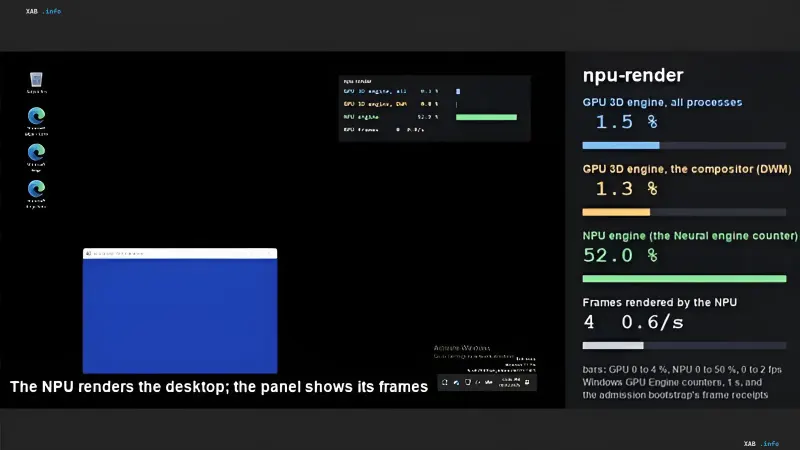
The main limitation of the prototype is speed. The refresh rate is currently only 2–3 Hz, while the developers' target figure is 30 Hz. Nevertheless, the experiment has already shown measurable effects: GPU utilization during 3D graphics processing dropped from 3.4% to 0.6%, and the monitoring panel shows that a significant portion of the load shifted to the neural processor counter (around 52%), with frames rendered specifically by the NPU being recorded. This confirms the operating principle of the scheme, although smoothness is still far from comfortable for daily use.
Hardware base, license, and project status
Tests are conducted on a laptop with an Intel Panther Lake processor, equipped with a fifth-generation NPU with a performance of 45–50 TOPS. The project's source code is published on GitHub under the Apache 2.0 license, which allows the software to be used for any purpose. At the same time, the authors emphasize that the npu-driver remains a research prototype, not a finished product, and further work is primarily aimed at increasing the refresh rate and rendering stability.