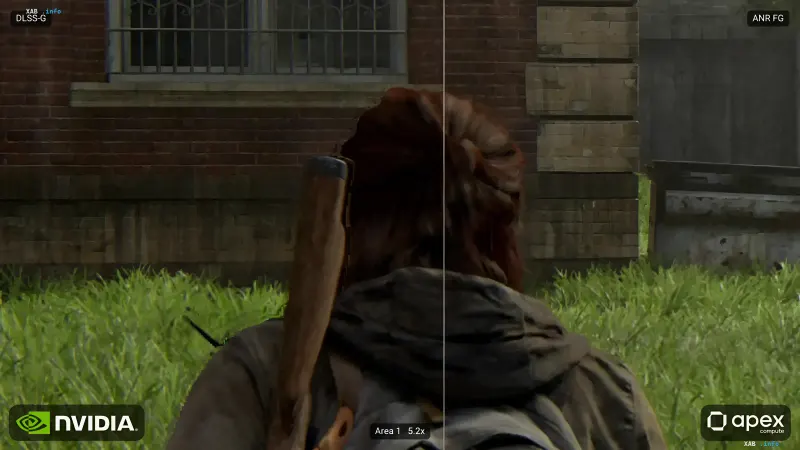
A new versatile contender for the frame generation standard has emerged in the graphics accelerator market. Apex Compute has announced Apex Neural Rendering (ANR), an open-source software solution that includes a built-in frame generator. The project is positioned as an alternative to proprietary technologies from Nvidia (DLSS), AMD, and Intel, with developers focusing not only on speed, but also on image quality and broad compatibility with graphics cards from various vendors.
What is Included in the Project and What Lies Ahead
According to the authors, the current version of ANR focuses on frame generation, but future plans include expanding functionality: scaling models (upscalers) and, according to the developers, ray reconstruction will be added to the project. The open-source nature makes the solution attractive to the community, allowing users to study, modify, and integrate it into their own pipelines—something competitor closed solutions do not allow.
Performance: The 2.4x Figure and Benchmark Data
The developers claim their solution delivers 2.4 times the performance of DLSS while providing better image quality. Third-party tests, according to the source, confirm at least the first claim. The Apex benchmark results table for 4K resolution on an RTX 5090 graphics card shows ANR values of 0.34, 0.53, and 1.13 in 2x, 3x, and 4x modes respectively, whereas DLSS frame generation shows 0.81, 1.08, and 1.27. Specifically, the ratio in 2x mode (0.81 versus 0.34) yields the approximately 2.4-fold advantage cited by the authors.
Image Quality: Fewer Artifacts, But Close-Up Verification Needed
The image quality can be assessed from the video published by the authors. At a minimum, a noticeably lower number of artifacts is visible compared to the baseline, although objective evaluation requires pausing the frame and zooming in significantly. This means the difference in quality is hard to spot at a glance, and the final verdict on the image remains a matter of subjective assessment.
Hardware Support and Availability
Software support is already extensive: GeForce starting from RTX 20 and even GTX 16, Radeon RX 5000, RX 6000, RX 7000, and RX 9000 lineups, as well as Steam Deck. The list includes Intel Arc A/B graphics cards and even Apple chips starting from M1. The project is currently in beta and available via OptiScaler or directly from the developers. Thus, ANR offers a broad compatibility matrix right at launch, which is a notable advantage for an open-source frame generation tool over niche solutions from individual vendors.