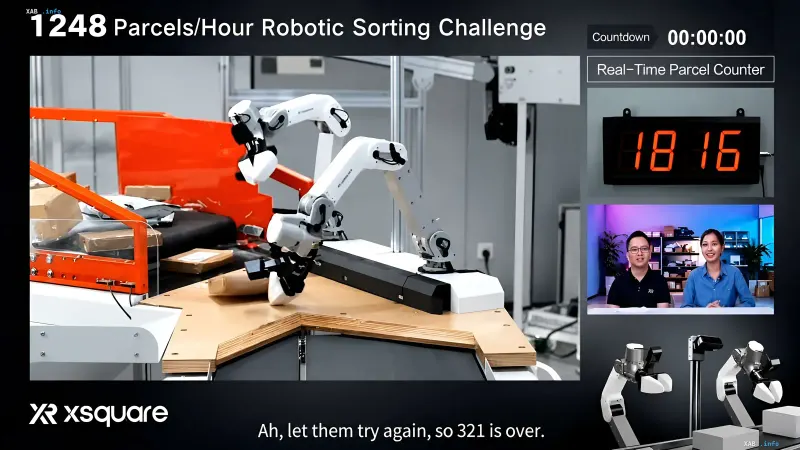
A significant shift has occurred in the field of logistics artificial intelligence. On August 12, 2026, X Square Robot conducted a public demonstration of its stationary robotic system, which managed to sort 1,816 parcels in a single hour. This event, broadcast as a continuous live stream, has set a new benchmark for the warehouse automation industry, challenging current market leaders.
Demonstration Details and Performance Metrics
According to official statements from X Square Robot, their system, equipped with two robotic manipulators, demonstrated unprecedented speed. A key factor in its success was not only the speed of grasping but also high precision: the company recorded a successful processing rate of over 98%. The event broadcast, confirmed by Pandaily, was unedited, allowing viewers to observe the algorithms and mechanics in real time. A digital counter on the stream screen tracked every processed unit, reaching a final value of 1,816.
Comparative Analysis with Figure AI
The result from X Square Robot immediately attracted analyst attention in the context of recent achievements by Figure AI. During previous trials, Figure AI humanoid robots processed 249,560 parcels over 200 hours. A simple arithmetic calculation shows an average Figure AI productivity level of 1,247.8 parcels per hour. Thus, the X Square Robot figure exceeds the Figure AI result by approximately 45%. However, experts emphasize that a direct comparison of these figures requires caution, as the system architectures differ radically: X Square used specialized stationary manipulators with simple grippers, whereas Figure AI employs humanoid robots, implying a more complex and expensive workflow organization.
Contradictory Data and Lack of Independent Audit
Despite the impressive figures, discussions have arisen within the technical expert community regarding the testing methodology. The public demonstration by X Square was not accompanied by an independent technical audit or a log of operator interventions. Unlike standardized benchmarks, the test conditions remained under the manufacturer's full control. It is unknown whether the parcel sets used in the X Square and Figure AI tests were identical, as well as exactly how error criteria were defined. Furthermore, there is no data on how frequently operators intervened to correct failures, which is critical for assessing the system's true autonomy.
Prospects for Implementation in Real-World Logistics
Nevertheless, a continuous hour of operation provides more information than short demonstration clips. Observing the system over an extended period allowed for an assessment of cycle repeatability and the robots' ability to recover from errors. To evaluate the readiness of such systems for real-world deployment in large warehouses, reproducible tests on a control set of parcels will be required. Investors and logistics operators need data not only on speed but also on the cost per parcel, energy consumption, safety, and ease of integration into existing infrastructure.