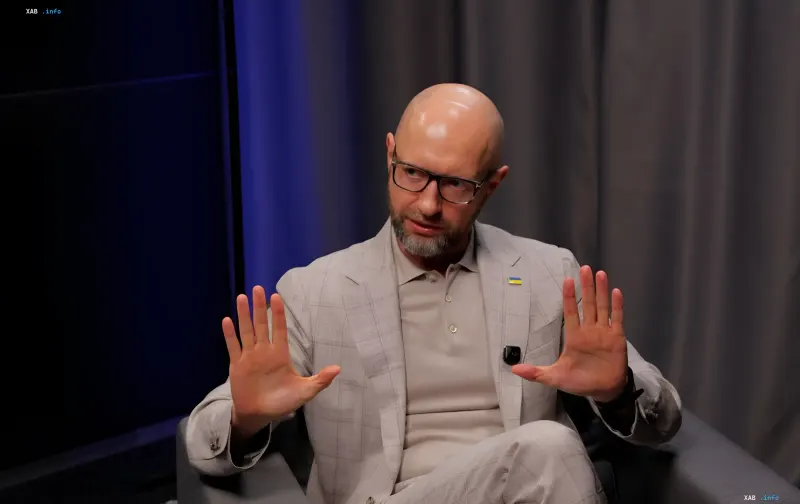
Former Ukrainian Prime Minister Arseniy Yatsenyuk, in an interview with RBC-Ukraine as part of the special project "Ukraine: 35 Years of Independence," publicly acknowledged that he had greatly underestimated the power of the information machine and the scale of discreditation campaigns directed against his government. According to the politician, it was around one of the key projects of his cabinet — the engineering development of the state border with Russia — that the largest number of myths and manipulations formed, which, in his assessment, continue to live in public consciousness to this day.
An "Iron Dome" made of iron and a "firewall" made of fire
Yatsenyuk explained that the government had explained in detail the key objectives of the project, but part of society took the name "Wall" too literally, imagining a solid concrete fence along the entire border. The former prime minister gave a number of analogies to illustrate the absurdity of such a perception: "It's like thinking that the 'Iron Dome' over Israel should literally be made of iron, or that an antivirus Firewall in a cyber network is actually fire. Well, I couldn't have thought of such a thing. And that's my problem, I should have thought about it." He emphasized that the project was about a comprehensive engineering system, not a physical monolithic barrier.
What the "European Rampart" actually provided for
The "European Rampart" project, which in public discourse was called the "Wall," was approved by the Cabinet of Ministers in the autumn of 2014. According to its technical specification, the construction of anti-tank ditches, observation towers, dome video cameras, and various engineering barriers was planned along the Ukrainian-Russian border. In 2015, the Ukrainian Border Service stated that the total cost of implementing the project would not exceed 4 billion hryvnia. Thus, the project was predominantly of a defensive-engineering nature and did not envisage the construction of a single continuous wall in the everyday sense of the word.
Construction progress and regional asymmetry
According to data released in September 2016, the overall readiness of the "Wall" on the border with Russia was about 12%. At the same time, the regional dynamics varied significantly: in Kharkiv Oblast the figure reached 47%, and in Chernihiv Oblast — 46%. This asymmetry was explained by the different length of border sections, the terrain, and the priority of directions, but it was precisely the gap between the national figure of 12% and the regional values above 40% that could further fuel public discussions about the "incompleteness" of the project.
Critical thinking as a vulnerable point
Summing up his reflections on the communication failure, Yatsenyuk stated that the situation had underscored the acute need to teach society critical thinking, although, in his words, this process turns out to be extremely difficult and ambiguously perceived. "Well, you only start teaching people to think critically, and what do they start doing? They sincerely hate you," the former prime minister concluded, acknowledging that he had not taken into account how quickly simplified narratives could push technical explanations out of the public sphere. His statement was made in the context of the 35th anniversary of Ukraine's independence and became one of the few public admissions of a systemic error in the work of the 2014–2016 government.