In November 2026, a project emerged online that caught the attention of the DIY electronics community: an enthusiast known as Huy Vector DIY independently built a functional smartwatch with electronic components costing no more than $10. While the device's capabilities are comparable to ready-made fitness trackers, its key distinction is the complete transparency of its design and the ability to modify it independently. The author published all project details in the public domain, including a parts list with supplier links, wiring diagrams, and software.
The Hardware Core: Development Board Instead of a Factory Module
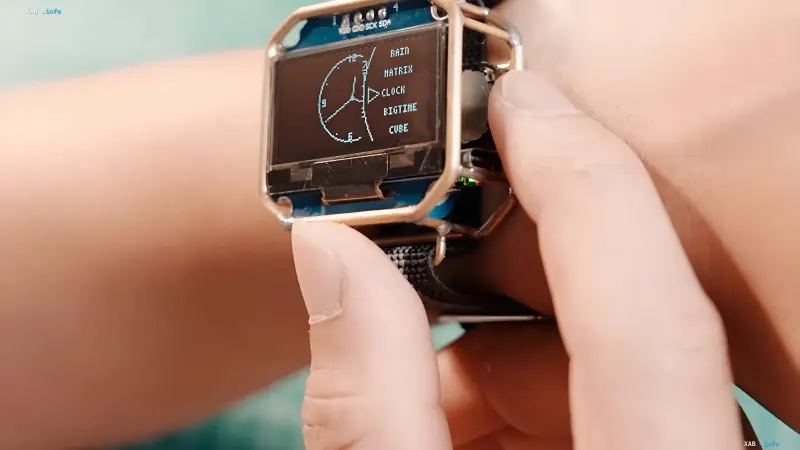
At the heart of the watch is a compact ESP32-C3 Super Mini development board—one of the most affordable modules based on the Espressif chipset, widely used in prototyping and IoT projects. Connected to the board are a 1.3-inch OLED display, a three-position control button, and a 3.7V lithium-ion battery. Charging is handled directly via a USB-C port integrated onto the board itself, eliminating the need for a separate charge controller. A photo of the device reveals a blue printed circuit board with pin labels (VDD, GND, SCK, SDA) at the top of the case, alongside an OLED matrix displaying a watch face selection menu with RAIN, MATRIX, CLOCK, BIGTIME, and CUBE options.
NWatch Firmware: Bluetooth, Notifications, and Watch Faces
The watch is powered by the free NWatch firmware, which provides Bluetooth connectivity to a smartphone. The device synchronizes time, displays incoming notifications and calls, and offers several watch face styles ranging from classic analog hands to minimalist digital layouts. On-screen in the photo, a stylized peace sign watch face with 12, 3, 6, and 9 o'clock markers highlights the interface customization available to the user without relying on third-party services.
A Brass Case with a Steampunk Vibe
The watch frame is constructed from a brass tube, giving the device a distinct steampunk aesthetic: the open design lets you see the circuit board, wires, and mounting elements. This aesthetic was deliberately chosen by the author as part of the concept—the watch looks less like a mass-market gadget and more like a handcrafted artifact. However, the open architecture does not provide full water resistance; the case lacks hermetic sealing, and water ingress could damage the components. Nevertheless, during testing, the device survived a short immersion in a glass of water, which Notebookcheck attributes to a water-repellent coating on the board.
Who Is This Project For and What Do You Need?
Replicating this build is not for everyone: the project requires solid soldering skills, an understanding of ESP32 family boards, and basic electronics knowledge. There is no ready-made out-of-the-box solution here—the user assembles the device from individual components, solders the display, button, and battery, and then flashes the board. In return, the enthusiast gains complete freedom: the ability to change firmware, add custom features, and experiment with the interface and hardware. For those already working with Arduino and ESP platforms, the project offers a compact and inexpensive way to get a personal smartwatch without overpaying for a brand and marketing markup.
Open Access and Project Context
Author Huy Vector DIY has released all materials—from the BOM list and 3D housing drawings to the source code of the firmware—in open access, allowing anyone to replicate the device. The project was initially covered by Notebookcheck and subsequently picked up by tech portals. At a time when mainstream smartwatches start at $30–50 and fitness bands at $15–20, a $10 solution remains niche, but it demonstrates that core smartwatch features—time, notifications, Bluetooth synchronization—can be achieved on a minimal budget with tools and patience.