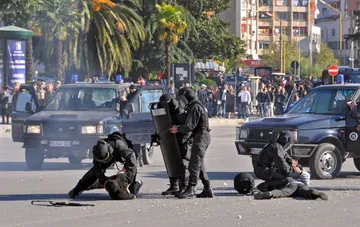
Since May 2026, mass protests have been ongoing in Albania, which society and the media have begun calling the "Flamingo Revolution." The catalyst for people taking to the streets was a plan to build a hotel complex in a nature reserve—the habitat of pink flamingos, which reportage links to the interests of Donald Trump's son-in-law Jared Kushner. Initially, the actions were peaceful, but in October the situation escalated sharply: following the violent dispersal of a student demonstration, the protest shifted into a phase of street battles and riots. It was from this moment, according to correspondents' observations, that the international community showed genuine interest in what was happening in Albania, and a significant number of foreign observers and journalists are now present in the country.
"We" vs. "They": Anatomy of a Conflict
At the center of events is Tirana, where clashes are taking place on Deshmoret e Kombit Boulevard, located between the Prime Minister's office and the "Twins" glass business complex: stones, fireworks, and Molotov cocktails are being hurled at police, while law enforcement responds with water cannons. In the middle of the boulevard, a bonfire burns made of chairs that Prime Minister Rama had previously carried out of the government building and placed in the square as a performance symbolizing readiness for dialogue; protesters perceived the gesture as mockery and burned the furniture. Reportage respondents consistently divide society into "we" and the state into "they," pointing out that the conflict has deep social roots stretching back decades, with the protest serving merely as their visible manifestation. Young participants, many of whom are students, formulate their demands broadly: the fight for "their future," dissatisfaction with police actions, corruption, the quality of education, and a lack of economic opportunities, and ultimately—the desire to "change the system completely."
A City Paralyzed
A special role in the paralysis of Tirana is played by the sabotage of urban infrastructure: according to eyewitnesses on the ground, a significant portion of traffic lights and street cameras has been disabled, causing miles-long traffic jams on the roads for weeks, regardless of whether protesters block streets. On Durres Street, leading from the center toward Sazan Island and the Zvernec beach, a dense concentration of students, the press, and a police water cannon surrounded by a line of shield-bearing riot police has been recorded. Nearby is the Ministry of Education and Sports, where a harsh dispersal of a student action recently took place—the very event that, according to participants, pushed the protest into a violent phase; the ministry building has no intact windows left.
Eco-Activism as a Trigger
Among the key figures participating in the protests from the first days is Besjana Guri, head of the environmental organization LUMI, who has worked in eco-activism for about thirteen years and received international recognition, including the so-called "Green Nobel" and inclusion in the TIME100 Next list. Guri is known for successful campaigns, including Save The Blue Heart of Europe to protect the Vjosa—one of Europe's last wild rivers, which, she says, is once again under threat. The Vjosa flows into the Adriatic Sea, and in the Narta Lagoon lies the tiny island of Zvernec with an ancient monastery among cypresses—part of the very natural landscape around which the conflict flared up. Thus, the local environmental dispute over the reserve and flamingos has become intertwined with a broader socio-political crisis in which protesters see a reason to overhaul the entire system of power.