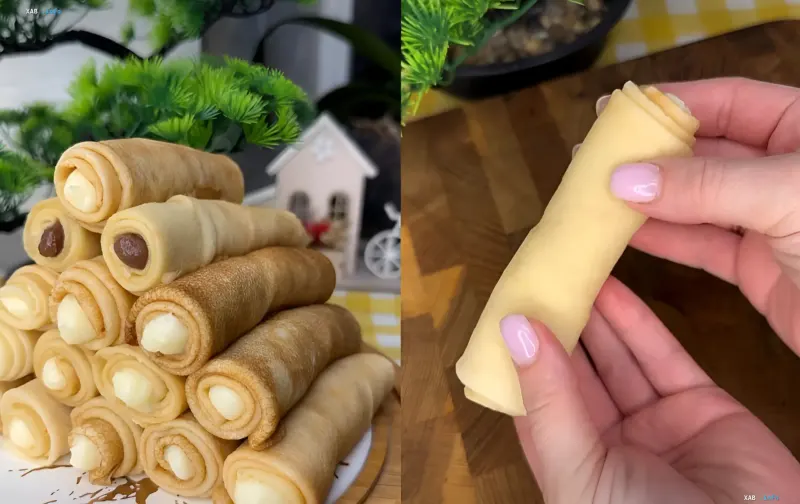
Sometimes a truly delicious dessert doesn't require pricey ingredients or complex pastry techniques. Pancakes with pastry cream are exactly that kind of homemade treat, a recipe shared by the project Styler, referencing an Instagram post by blogger danilchenko_77. They are made from everyday products that are easy to find in any store, and the pastry cream gives the dessert a delicate texture while perfectly complementing the taste of the thin pancakes. Below is the step-by-step logic of preparation, which you can recreate at home without any special training.
Boiling-Water Batter: The Base for Thin Pancakes
The process begins with a classic set of ingredients: eggs are mixed with sugar and a pinch of salt, milk is poured in, vegetable oil is added, and flour is gradually sifted in. The batter is mixed until smooth, with no lumps left, and then 300 ml of boiling water is poured in and stirred thoroughly once more. It is the hot water that "cooks" part of the flour, which is why the pancakes turn out elastic, thin, and resistant to tearing when rolled up. Once the pan is heated, the pancakes are cooked until done on both sides.
Pastry Cream: What Holds the Dessert Together
The cream is prepared in parallel. In a saucepan, an egg, sugar, and starch are combined, milk is added, and the mixture is placed over low heat. While stirring constantly, the mass is brought to a thick consistency, after which 50 g of butter is folded in, mixed well, and left to cool. The starch here acts as a stabilizer: the cream holds its shape and doesn't leak out of the rolled pancakes, while the butter gives it a velvety texture and a rich flavor.
Assembly, Chilling, and Serving
The cooked pancakes are spread with pastry cream and stacked one on top of another to form a layered dessert. Before serving, it is recommended to chill it slightly: this helps the cream set better and keeps the pancakes from falling apart when cut. The result is a delicate, fragrant, and filling dessert that, thanks to its simple ingredients, can be made without significant expense.
Contradictory Data
It is worth noting one inconsistency in how the material is presented. The headline introduces the reader to a "three-glass" recipe, yet in the actual recipe text the exact "three glasses" measurement is not specified for either the flour or the milk: only 300 ml of boiling water and 50 g of butter for the cream are clearly stated. Thus, the title promises a specific measure, but the main text does not disclose it. A reader who wants to recreate the dessert precisely should rely on proportions tested in their own experiments, or look for the extended version of the recipe at the original Instagram source, where the full gram measurements are likely provided.
Overall, the recipe remains one of the most accessible ways to make a homemade dessert: a minimum of ingredients, a clear technique, and a result that is no worse than store-bought sweets. For those looking for variations on the theme of pancake desserts, more complex constructions are made in the same spirit — from pancake cakes with chocolate and berries to a delicate "Napoleon" using pancakes instead of pastry layers.