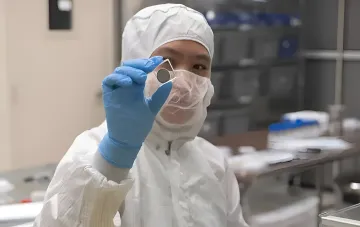
A research team from the Shenzhen Institutes of Advanced Technology under the Chinese Academy of Sciences, in cooperation with several academic institutions, has presented the results of developing ultrathin lithium anodes for rechargeable batteries. The key innovation lies in applying a screen-printing method, which produced anodes with equivalent thicknesses of 10, 20, and 28 micrometers. In one of the experimental configurations—featuring a nickel-containing cathode and a 20-micrometer anode—the calculated energy density reached 504 Wh/kg and 1071 Wh/L, significantly exceeding the metrics of most commercial lithium-ion batteries used in electric vehicles today.
Screen Printing Instead of Deposition: How the Anode is Formed
The technological approach used by the researchers differs fundamentally from traditional methods of forming lithium anodes. Molten lithium is applied onto a copper substrate through a special screen mask, resulting in the formation of uniform microdisks on the surface. This approach ensures controlled lithium distribution across the anode area and allows precise specification of the layer thickness. According to the publication, experiments yielded three anode variants—10, 20, and 28 micrometers in equivalent thickness, opening up the possibility of matching configurations to specific battery weight and capacity requirements.
Dendrites and the Role of Magnesium in the Protective Layer
One of the fundamental problems of metallic lithium as an anode material remains the formation of dendrites—thin needle-like crystalline structures that grow during cycling and can cause internal short circuits, capacity degradation, and fire hazards. To suppress this effect, researchers added a magnesium compound to the molten lithium. According to experimental results, magnesium promoted the formation of a protective layer on the anode surface, reducing the intensity of unwanted side chemical reactions and decreasing irreversible lithium losses during each charge-discharge cycle.
Laboratory Test Results: 260 Cycles and Over 99.8% Efficiency
During laboratory tests, batteries equipped with anodes just 10 micrometers thick demonstrated stable operation for over 260 charge-discharge cycles with a coulombic efficiency exceeding 99.8%. This metric indicates that active lithium losses per cycle are extremely small, and capacity degradation within the tested range remains within acceptable limits. In the configuration with a nickel-containing cathode and a 20-micrometer anode, the calculated specific energy density was 504 Wh/kg, and the volumetric density was 1071 Wh/L. The researchers also tested the developed technology in batteries with a gel electrolyte, expanding the range of potential design solutions.
From Lab to Production: Prospects and Limitations
At the current stage, all obtained results are laboratory-based and do not reflect industrial serial production conditions. Transitioning from experimental prototypes to mass production will require solving challenges in scaling up screen printing, ensuring parameter stability over large anode areas, and integrating the technology into existing production lines. Nevertheless, according to the authors, the method is potentially applicable in batteries for electric vehicles, portable electronics, and stationary energy storage systems. If the technology is successfully scaled, ultrathin lithium anodes could become one of the paths enabling simultaneous reduction of battery pack weight and increase in electric vehicle driving range without a substantial cost increase.