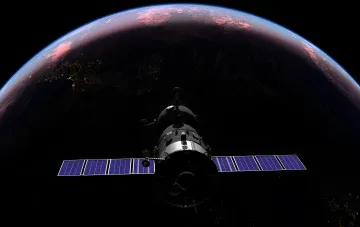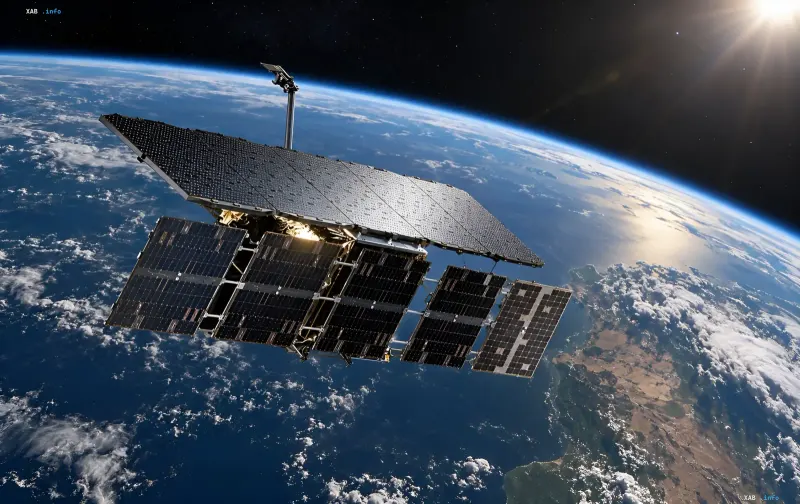
Russian military satellite Cosmos 2612 has performed a series of complex orbital maneuvers, entering a trajectory that virtually matches the orbit of the Finnish radar spacecraft ICEYE-X36. According to analysts cited by RBC-Ukraine referencing The Hitchhiker's Guide to Self-Preservation, the Russian spacecraft burned a significant amount of fuel to synchronize its orbit with that of the satellite which, according to Western sources, is used to provide satellite data to the Ukrainian Defense Forces. Cosmos 2612 reached an altitude of about 555 km with an inclination of 97.8 degrees and a speed identical to ICEYE-X36's parameters, which analysts classify as entering a "coplanar" orbit—a regime where two spacecraft move in the same plane and can maintain a set distance.
From 320 kilometers to five in a day
Space reconnaissance company LeoLabs recorded that as of Friday, October 16, the distance between the two spacecraft had shrunk to approximately five kilometers. Just a day prior, according to the same specialists, the distance was over 320 km. Such a sharp approach in low Earth orbit requires precise calculation and significant fuel expenditures, which experts assess rules out coincidence and points to deliberate actions. LeoLabs specialists emphasize that such behavior for low-orbit spacecraft is rare and indicates the deliberate nature of the maneuvers.
Threat scenarios seen by analysts
Aerospace industry analysts highlight several potential threats associated with the Russian spacecraft's presence in the immediate vicinity of the Western satellite. These include the possibility of data transmission interference, physical inspection or equipment damage, as well as preparation for kinetic or non-kinetic anti-satellite action. Integrity ISR space analyst Greg Gillinginger noted that Russia's readiness to spend fuel on changing its trajectory confirms a direct interest in the satellite supporting Ukraine. According to him, choosing the "bumper-to-bumper" mode—moving in close escort—is the most telling signal of intent.
Positions of the parties: from Finland to Moscow
Representatives of Finland-based ICEYE, the operator of the ICEYE-X36 spacecraft, declined to comment on the situation. A Ukrainian official in conversation with journalists confirmed that the Ukrainian Defense Forces cooperate with the Finnish company and use its satellite capabilities, but did not specify whether the ICEYE-X36 apparatus specifically is involved in these processes. At the same time, Russian propaganda media publicly stated that Cosmos 2612 "caught up" with the Western apparatus, which they describe as a "spy satellite", without disclosing the details of the maneuvers or commenting on LeoLabs' data regarding the distance reduction.
Context: a rare low-orbit precedent
Experts emphasize that the targeted approach of one state's military satellite to another's civilian or reconnaissance spacecraft in low Earth orbit remains a rare precedent. Unlike geostationary orbit, where spacecraft move at predictable speeds, at an altitude of about 550 km even small parameter changes lead to rapid trajectory divergence, making holding a distance of a few kilometers a technically complex and resource-intensive task. Therefore, according to analysts, the very fact of maintaining position for a day or more is an independent signal of the priority Moscow assigns to this object.