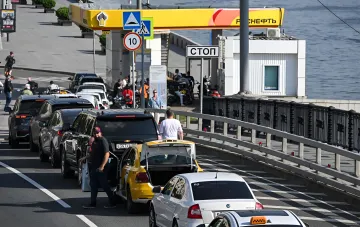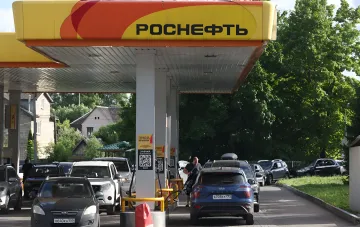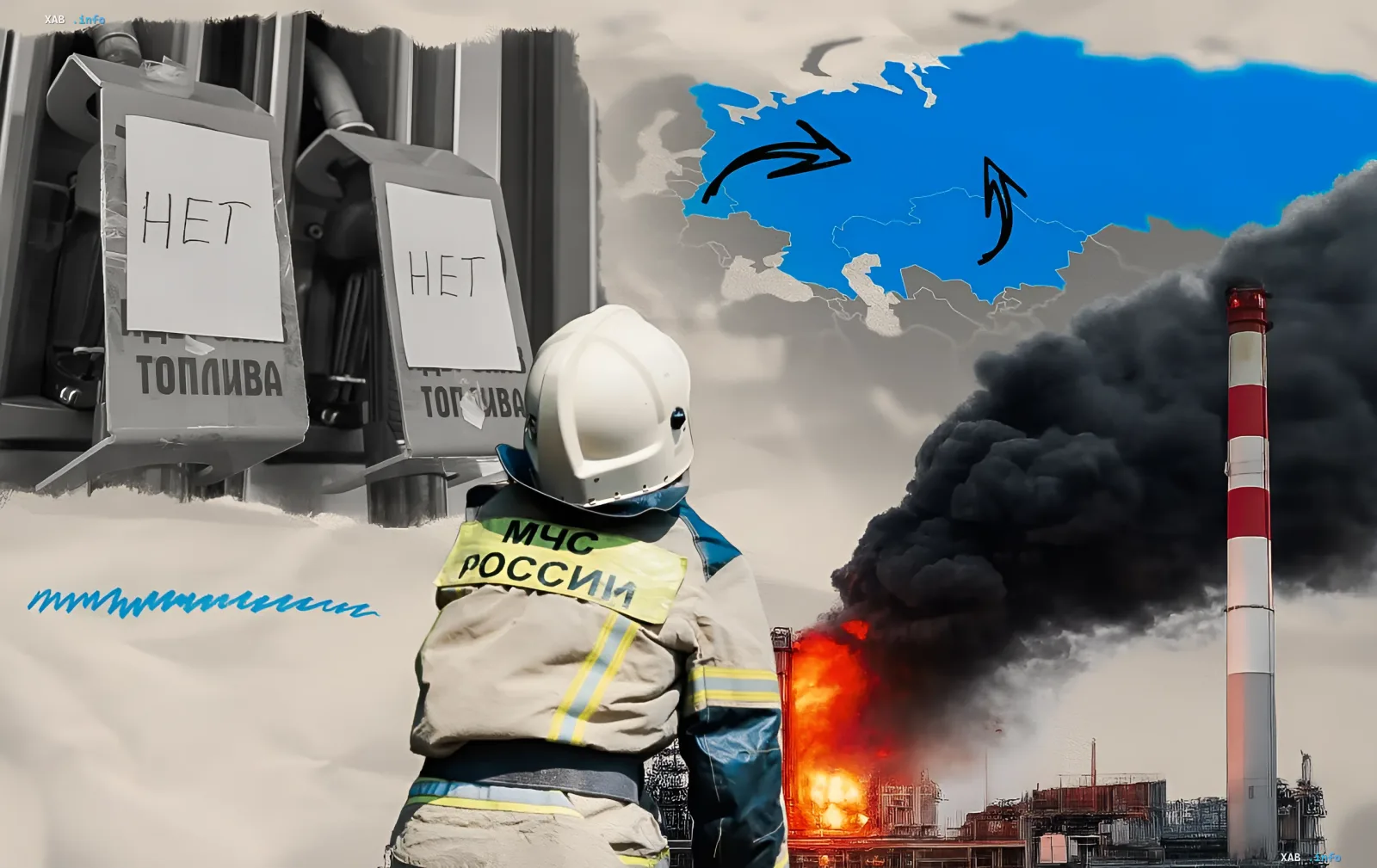
In the summer of 2026, the fuel crisis in Russia reached its largest scale since the start of the full-scale invasion of Ukraine. According to data published in an RBK-Ukraine article, systematic strikes by the Defense Forces on oil refining infrastructure have forced the Kremlin to turn to importing petroleum products — a step that, for a country long considered one of the world's largest fuel exporters, is a sign of deep structural breakdown. Dozens of regions have introduced restrictions on gasoline sales at gas stations, and calls by local authorities for residents to cut down on car trips and use public transport have effectively become a marker that the shortage has ceased to be local and turned into a nationwide problem.
Strikes on Refineries: How Nearly 40% of Capacity Was Knocked Out
Between January and May 2026, according to Vladimir Zelensky, the Defense Forces struck 15 Russian oil refineries, as a result of which by May nearly 40% of primary oil refining capacity had been taken out of service. Although in July–August some strikes were redirected at the Wildberries logistics network, Ukrainian drones continued to effectively hit key nodes of major refineries. Notably, long-range strikes reach even plants beyond the Ural Mountains: the most distant target was the Omsk Refinery, located 2,500 kilometers from the Ukrainian border and the most powerful oil refinery in the Russian Federation.
Refining at a 21-Year Low
By mid-August, Russian oil refining had fallen to its lowest level in the past 21 years — 3.9 million barrels per day, according to Bloomberg. Even official OPEC statistics, based on data from Russia's Ministry of Energy, confirm the fact of the decline: in the second quarter of 2026, refining volumes fell by 21% compared with the same period in 2021 — to 4.5 million barrels per day. Boris Dodonov, head of the KSE Institute's Center for Energy and Climate Studies, citing International Energy Agency data, notes that the reduction in refining has forced Russian companies to cut raw material extraction as well: oil production in Russia is now at its lowest level in the past 15 years.
A Paradox for the OPEC+ Rule-Breaker: Output Below Quota
Previously, Russia had consistently violated its commitments to OPEC+, extracting more oil than the quota agreed with the cartel allowed. "Now they are producing less than their quota," Dodonov emphasizes. This is a fundamental shift: a country that for years used above-quota production as a tool of influence on the market is now forced to shrink below its own commitments. Facing refining problems, Russia is increasingly shipping oil to the world market — a trend that became especially pronounced in February–June 2026, when Ukrainian drone strikes on refineries intensified.
Where the Oil Goes: China, India, Turkey
According to data from the Kyiv School of Economics, the main buyers of Russian oil throughout the war have remained China, India, and Turkey. Last year, Indian Prime Minister Narendra Modi promised the United States to give up Russian raw materials, but failed to keep that promise, which drew Donald Trump's displeasure and a new package of tariffs against New Delhi. Nevertheless, Indian oil companies continue to contract Russian crude, which sustains the outflow of oil from the Russian Federation and deprives the domestic market of fuel that, ideally, should have been refined at home.
Fuel Collapse in the Regions and Emergency Imports
The drop in fuel production has led to the sharpest crisis since the start of the invasion: there were problems in 2024 and in the summer of last year, but in 2026 the shortage has been the most acute. "The peak of the fuel shortage in Russia came in June, when refining fell to 3.8 million barrels per day against total refinery capacity of 6.3 million barrels," Dodonov says. Dozens of regions have introduced restrictions on gasoline sales, even the Moscow region has felt the problems, and rising fuel prices have been passed on to transport costs. "The current fuel crisis has engulfed all regions of Russia. They are reaping the fruits of the deepest shortage due to the increased intensity and number of strikes," comments Alexander Syrenko, an analyst at NaftoRynok. To smooth out the consequences, Russia in early July restricted diesel exports and, in parallel, ramped up gasoline imports to close the gap between production and domestic demand.
Contradictory Data
Different sources provide somewhat diverging figures, which is important to keep in mind when assessing the scale of the crisis. Bloomberg records 3.9 million barrels per day as of mid-August; Dodonov cites 3.8 million barrels per day as the June minimum; official OPEC statistics (based on data from Russia's Energy Ministry) point to 4.5 million barrels per day as the average for the second quarter. These values are not a direct contradiction — they reflect different time windows (a quarterly average versus peak weeks) and different methodologies, but the spread itself creates uncertainty. Moreover, Zelensky estimates the knocked-out capacity at nearly 40% by May, whereas official Russian reporting to OPEC, relying on its own Energy Ministry data, may understate the real damage. Thus, the "official" picture is likely softer than the factual one, and the precise level of capacity losses remains a matter of assessment.