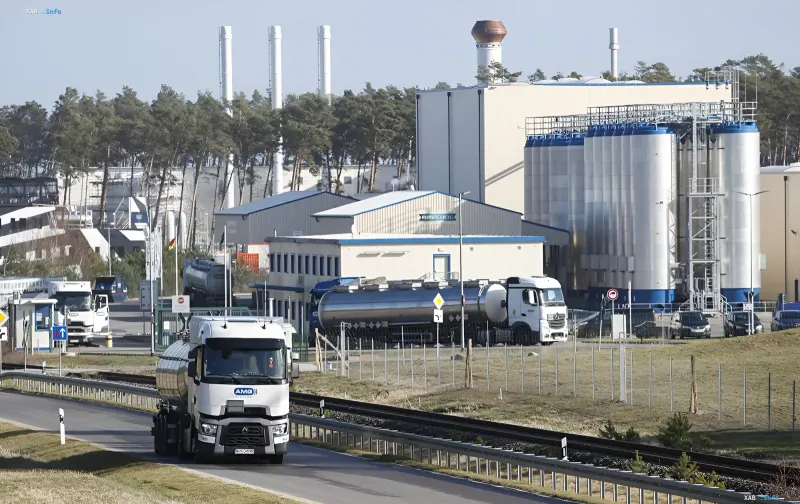
The federal government of Germany has officially confirmed that the issue of commissioning the Nord Stream 2 pipeline is not on the agenda, despite reports that Washington previously offered Berlin to assist in restarting it to resume Russian gas supplies to Europe. This is evidenced by the cabinet's response to a parliamentary inquiry from the Alternative for Germany (AfD) party, cited by specialized media with reference to RBC-Ukraine. Thus, Germany has publicly recorded its refusal of a step that, against the background of ongoing negotiations between the US and Russia, was viewed by a number of observers as a possible element of energy settlement.
Official Stance of Berlin: Certification Remains Suspended
The federal government's document explicitly states that «the issue of commissioning Nord Stream 2 does not arise» for the cabinet, and the pipeline's certification procedure «remains suspended». This means that even the formal administrative procedures necessary to legalize the pipeline's operation have not been resumed. Berlin's position is not declarative but procedural: until certification is completed and resumed, physical startup is impossible, and the government itself states that it has no intention of doing so.
Context: From Supply Cuts to EU Sanctions
In substantiating its position, the German government recalled that after the start of Russia's full-scale invasion of Ukraine, Moscow consistently restricted natural gas supplies to Germany, and by the time of the pipeline sabotage in September 2022, supplies had been completely halted. In Berlin, these actions are regarded as direct evidence of Russia's unreliability as an energy supplier. Against this background, the European Union imposed large-scale sanctions against the Russian energy sector and, as part of the REPowerEU strategy, set a course for the gradual termination of energy dependence on the Russian Federation. The federal government, according to its own statement, «fully shares» these actions, which makes the restart of Nord Stream 2 incompatible with the current line of Brussels and Berlin.
Background: Washington-Kremlin Talks Surrounding the Pipeline
Talks about a possible restart of Nord Stream developed against the backdrop of a series of reports on contacts between the US and Russia. According to sources, in February, representatives of the two countries allegedly held closed-door negotiations on resuming the pipeline's operation with US participation, and in October it was reported that Russian President Vladimir Putin's advisor Kirill Dmitriev and Jared Kushner discussed the possibility of attracting an American investor to the project. In addition, the administration of US President Donald Trump reportedly offered Ukraine to resume the transit of Russian gas to Europe as part of a peace agreement, which was received extremely negatively by European officials. In the same talks, Nord Stream 2 was called one of the discussed objects, and one source described its restart in the event of a peace agreement as «the easiest step». At the same time, Germany itself, as the key European hub of the European gas system, found itself in a position where any such step requires its direct consent—and Berlin is not giving that consent.
Shadow of Sabotage and US Intelligence
Additional context is provided by information that the US Central Intelligence Agency, according to available data, knew about the plan to blow up the Russian Nord Stream pipelines as early as the initial stage of its preparation. This episode, along with the halt in supplies, cemented in German politics and society the image of the pipeline as an object associated with systemic risk and geopolitical pressure, rather than with reliable energy diversification. Taken together, these factors make the political will for a restart in Berlin minimal.
What This Means for the Energy Market
Germany's position effectively closes the short-term scenario for the return of Russian gas to the European system via Nord Stream 2 and confirms that the energy decoupling from the Russian Federation has become part of the wider EU sanctions and strategic architecture. For Europe, this means continuing the course toward source diversification and strengthening the role of LNG and alternative routes, while for Russia, it means the loss of one of the key export channels toward the West. Thus, even in the presence of diplomatic signals from Washington and Moscow, the practical path to restarting the pipeline at the current stage remains blocked by Berlin's own decision.