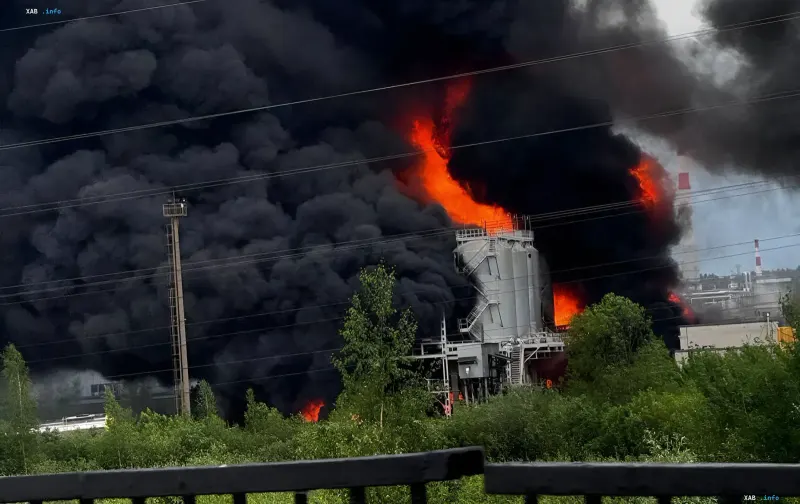
The Main Directorate of Intelligence of Ukraine (GUR) has released a large-scale assessment of the impact of Defense Forces strikes on Russia's oil refining infrastructure. According to the agency, as reported to RBC-Ukraine, by the end of September 2026, 15 out of 38 major Russian oil refineries had been completely taken out of operation, while another 12 had significantly reduced refining volumes. Total oil refining volumes at the affected facilities fell by 55.4% compared to the start of the year. Intelligence estimates the damage to the industry at over $23.2 billion — a figure almost comparable to the total revenue of the entire Russian oil refining industry for 2025 ($26.6 billion).
Geography of the Crisis: Volga, Central, and Southern Regions Under Greatest Pressure
The most acute situation, according to GUR, is in the Volga, Central, and Southern federal districts. Suspension or restriction of operations has affected the capacity of major enterprises such as PJSC Slavneft-YANOS, Kirishinefteorgsintez LLC, JSC Ryazan Oil Refining Company, JSC Gazpromneft-Moscow Refinery, and Lukoil-Permnefteorgsintez LLC. The combined share of these companies accounts for approximately 33% of total Russian oil refining, making their shutdown a critical factor for the country's entire fuel market.
Substitution via Remote Refineries: Limited Resource
At the same time, enterprises in remote regions — the Omsk, Achinsk, Khabarovsk, and Mari refineries — continue to operate. In September 2026, they processed 906,000 barrels per day, which is 147,000 barrels more than at the beginning of the year, accounting for about 24% of all oil refining in the country. However, as GUR emphasizes, the possibilities for such substitution are severely limited by geography: the delivery of petroleum products is complicated by a shortage of railway rolling stock and road tankers. Furthermore, in 2027, production volumes at these plants may decrease further due to the rescheduling of planned technical maintenance.
Information Blackout: Putin's Decree on Data Closure
The severity of the crisis is evidenced by Russian President Vladimir Putin's Decree No. 686 of September 28, 2026, which restricts access to information on oil refining volumes. According to intelligence estimates, this makes independent monitoring of the industry impossible and creates conditions for manipulating fuel production data, including for buying countries. The cost of replacing damaged equipment, according to GUR's calculations, taking into account international sanctions and the high cost of components, could exceed $20 billion.
Fresh Strikes: Ryazan and Yaroslavl
The pace of strikes against oil refining infrastructure has continued into the current month. In Ryazan, a local refinery was attacked, presumably by unmanned aerial vehicles; a fire broke out at the plant after the hit. On the night of November 3, 2026, drones attacked the Yaroslavl Refinery, one of the five largest in Russia. According to intelligence, the facility specifically provides fuel for military aviation and equipment. Despite attempts to redistribute the load among the remaining operational plants, Russia, according to GUR, has lost the ability to fully cover its own fuel needs and fulfill export obligations.