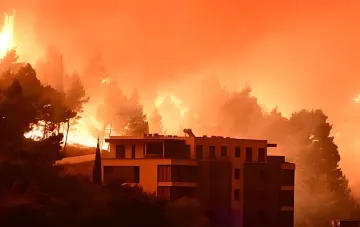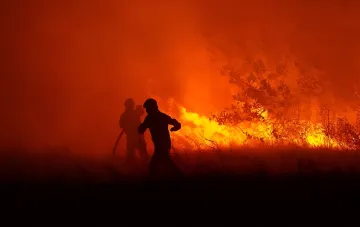
Europe is facing an unprecedented threat: uncontrolled wildfires in Spain and France have forced more than 250,000 people to flee their homes. Authorities in both countries have declared states of emergency and mobilized all available resources, including the military and international aid, to contain the inferno fueled by anomalous heat.
Fighting for Life: Record Evacuations
The scale of the tragedy goes beyond a typical summer season. In central Spain, where the fire has engulfed vast territories, approximately 70,000 residents have been evacuated. Spain has declared a nationwide state of emergency due to a wildfire for the first time in its history.
The situation in France is no less dramatic. Interior Minister Laurent Nuñez described the current evacuation as "probably the largest" in peacetime in the country's history. More than 197,000 people have been evacuated from French regions, including the suburbs of the famous wine-making center of Bordeaux. Police went door-to-door, personally informing residents of the need to immediately leave dangerous areas.
Fire Creating Its Own Climate
The fires have reached such intensity that they are beginning to influence local weather. French Prime Minister Sébastien Lecornu stated that the blaze in the Gironde region is so powerful that it is generating its own wind currents, fanning the flames.
"The fires striking our country have reached a level never seen before. Our priority is clear: protecting human lives," Lecornu wrote on social network X, urging citizens to unconditionally comply with evacuation orders. In some coastal towns where the fire came dangerously close, people had to escape by boat.
Mobilization of Military and Equipment
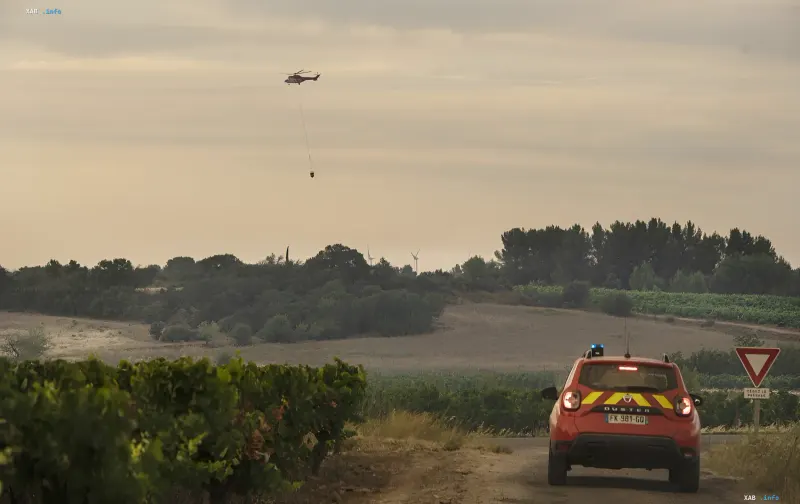
To fight the fire in France, 1,500 military personnel have been deployed. A military transport aircraft, the Airbus A400M Atlas, capable of dropping water, was urgently sent to the Gironde region, in addition to 18 other aircraft. The government also delivered 1.5 million protective masks to the population. Firefighters are digging trenches and using special chemicals (retardants) to slow the spread of the fire, trying to prevent it from reaching Bordeaux.
In Spain, the situation is complicated by strong winds. On Friday, two of the three major fires merged into one giant blaze. Although cooler weather on Saturday gave firefighters a "window of opportunity," forecasts remain pessimistic due to the unpredictability of the wind.
Tragedies and Ecological Crisis
The disaster has already claimed lives. On Saturday evening, the Spanish Ministry of the Interior reported the death of a man during a fire in Manises (Valencia) — his body was found in a car in a ravine. This incident is not related to the fires west of Madrid, where no casualties have been recorded yet. However, the Spanish Ministry of Health advised residents of the capital region not to go outside due to critical air pollution, smoke, and ash.
Prolonged heatwaves have turned forests into highly flammable material. According to Spanish Prime Minister Pedro Sánchez, 130,000 hectares of forest have already burned in the country this year — a third more than the annual average. In France, the fire has destroyed more than 98,000 hectares, which the Interior Minister called a "historic record".
International Aid and Political Context
Spain and France are not alone in the fight against the fire. Croatia, Czechia, Greece, Italy, the Netherlands, Portugal, and Slovakia have sent aid in the form of water-dropping aircraft and equipment. European Commission President Ursula von der Leyen confirmed the deployment of a rescue fleet: five aircraft and two helicopters are already working in France, and four more are arriving in Spain.
Wildfires this summer have caused not only humanitarian but also political tension. Earlier, Donald Trump criticized Canada because smoke from wildfires in that country enveloped a significant part of the US. However, it is worth noting that Washington regularly turns to Ottawa for help when wildfires rage in American states.