Hungary has resorted to unprecedented engineering measures to prevent an energy collapse. Due to a critical drop in the water level of the Danube River, caused by extreme drought, the country's authorities have launched an operation to artificially raise the water level near the Paks Nuclear Power Plant. This is necessary to keep the country's only nuclear power plant running, which is currently operating at only a quarter of its capacity.
Critical water levels and the threat of shutdown
As of August 15, 2026, the water level in the Danube at the water intake collectors of the Paks NPP has dropped to the minus 122 cm mark. Hydrologists warn that without intervention, the situation will worsen: by Sunday, a drop to minus 132 cm is expected, which will require the emergency shutdown of another turbine. The critical point is the minus 140 cm mark; upon reaching it, the plant will be forced to stop operations completely due to the inability to draw water for reactor cooling.
Engineering operation: sinking barges and an underwater barrier
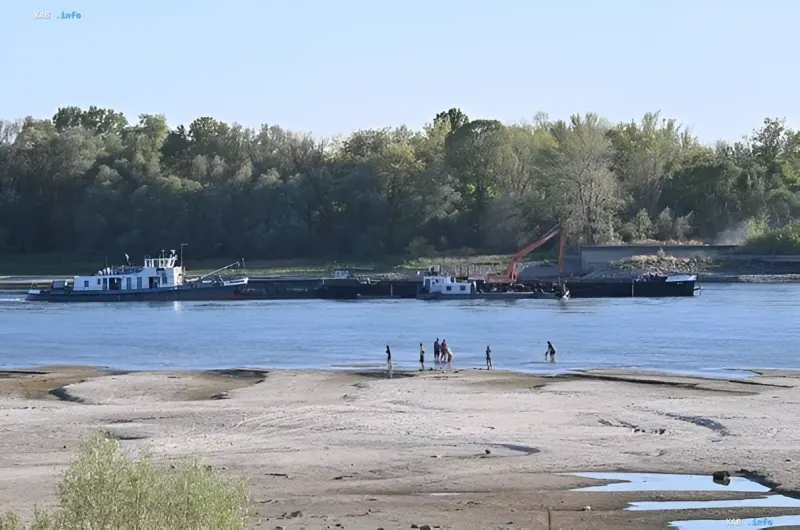
To buy time, the Hungarian government has deployed the army and special equipment. In the closed waters of the plant, two 80-meter barges were positioned perpendicular to the current and secured with 5-ton anchors. Industrial divers are conducting an operation to sink them in a controlled manner to create a temporary dam. This should raise the water level in front of the intake by at least 20 cm. Simultaneously, 100 soldiers are working around the clock to build an underwater stone sill on the riverbed, which requires the delivery of 150,000 cubic meters of stone.
Financial risks and political context
A complete shutdown of the Paks NPP would inflict colossal damage on the country's economy. According to calculations, the emergency purchase of imported electricity will cost the treasury at least $159 million per month. Authorities fear that further shallowing of the river will lead to the plant's shutdown, which will cost the economy at least $159 million monthly. Against this backdrop, Prime Minister Péter Magyar launched a harsh political attack on the opposition, accusing the previous authorities of strategic negligence and unpreparedness for climate challenges.
Contradictory data
There are discrepancies in the assessments of the prospects for the Paks II project. On the one hand, Prime Minister Péter Magyar officially expressed doubts about the expediency of completing the construction of new Russian reactors, stating that building new energy blocks while the Danube dries up is economic suicide. On the other hand, sources indicate that the project remains strategically important for the country's energy security, and the question of its implementation will be reviewed, but not cancelled outright. The opposition, however, insists on a complete halt to cooperation with Rosatom until the cooling problems are resolved.
European context
The problem is not limited to Hungary. Neighboring Romania has already completely shut down its Cernavodă NPP due to similar shallowing of the Danube. In France, due to river overheating and anomalous heat, the Ministry of Energy was forced to forcibly shut down 6 out of 57 nuclear reactors. The situation in Hungary has become part of a large-scale European energy crisis caused by climate change and extreme weather conditions.