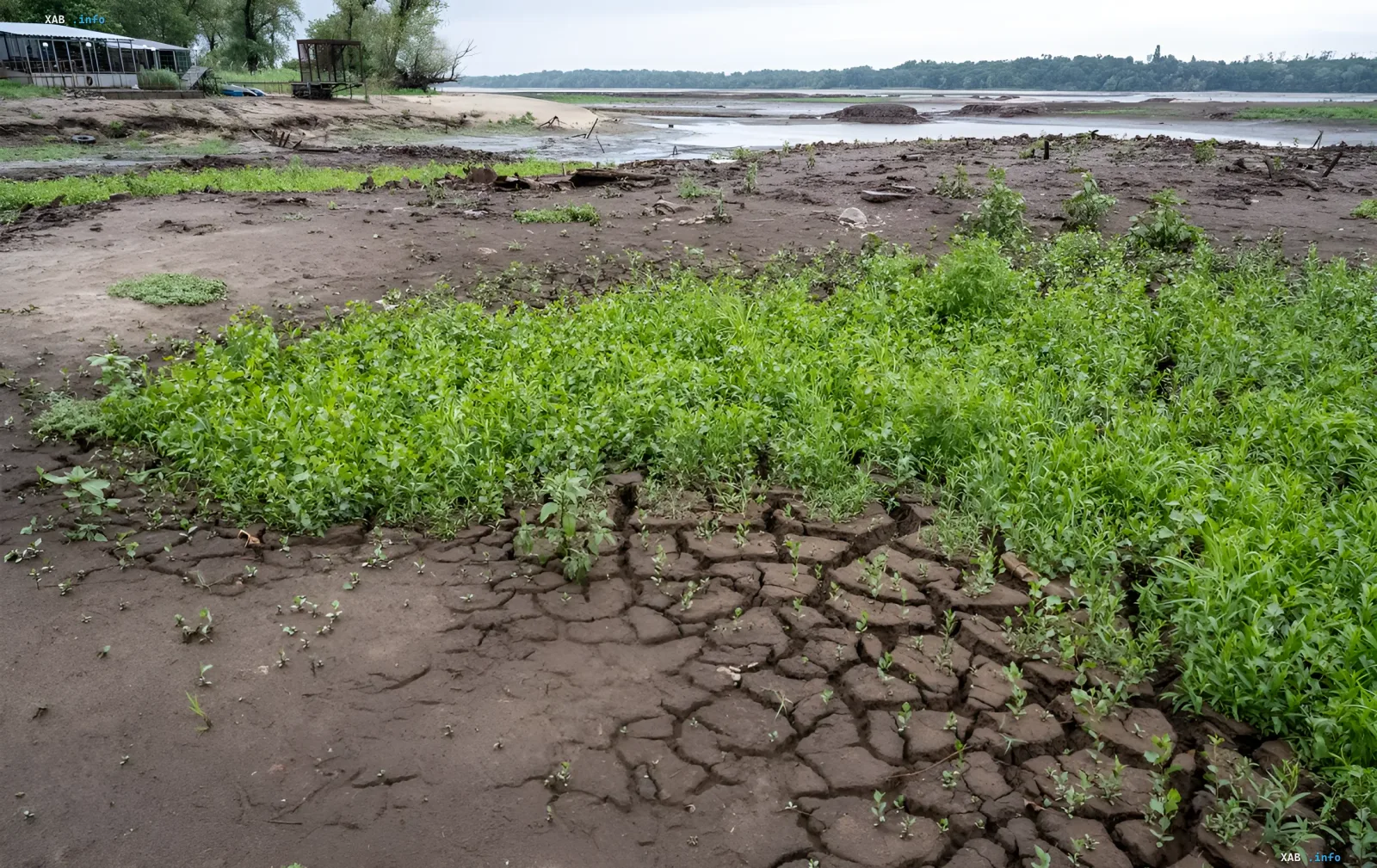
July 2026 entered the history of Ukraine's hydrometeorology as a month of sharp contrasts and critical deficits. According to data from the Ukrainian Hydrometeorological Center (UkrGMC), the water volume of most rivers in the country was significantly below normal, creating a threat to the functioning of aquatic ecosystems. Against the backdrop of a general trend towards low water levels, experts recorded a complex picture of precipitation distribution: from extreme downpours in some regions to a complete absence of rain in others.
Anomalous Distribution of Precipitation and Temperatures
Although the average monthly air temperature in July 2026 was 0.2–1.9°C below the climatic norm, this did not save the country's water arteries from dehydration. Precipitation fell extremely unevenly: ranging from weak rains to significant downpours. A precipitation deficit of 40–80% of the norm prevailed in most sub-basins. Only in the mountainous areas of the Carpathians and the far west did precipitation reach 90–110% of the norm. The most critical situation developed in the Pripyat and Desna sub-basins, where in some places only 28–35% of the necessary moisture fell.
Critical State of Ecosystems and Low Water Levels
Throughout the month, a regime of low summer low-water prevailed on the rivers, interrupted only by insignificant short-term rises in water levels. On the Southern Bug (Trostianchyk station) and other water bodies, the average water discharge in July was below the ecological threshold — from 53% to 96% of the norm. Experts from UkrGMC emphasize that this is critical for the functioning of river ecosystems. Low water levels based on the main assessment criterion (11–20%) were observed and maintained on a number of waterways, and in some places, water volume reached values close to the criteria for critical low water (21–30%).
Contradictory Data
The general picture of low water in July 2026 was not universal. While an acute deficit was observed in the south and center of the country, in the northeast of the Desna basin, values of 120–150% of the precipitation norm were recorded in some places. On the Ingulets River (Kryvyi Rih station), the water volume reached 285% of the norm. According to specialists, such spatial contrast reflects the local nature of rainfall: in some areas, 40–70% of the norm fell, in others — 100–200%, and in individual points — up to 300–320% of the norm. This creates a complex situation for forecasting and water resource management.
Long-term Consequences for Water Resources
The situation in July 2026 vividly demonstrates the vulnerability of Ukraine's water sector. The country ranks among the last in Europe in terms of freshwater reserves per capita. Many water bodies have already been lost, while others are polluted and dangerous for use. The critical reduction in river water volume during the summer period exacerbates the problem, making normal ecosystem functioning impossible and creating risks for agriculture and water supply. In the context of climate change and uneven precipitation distribution, Ukraine faces the need to revise water resource management strategies.