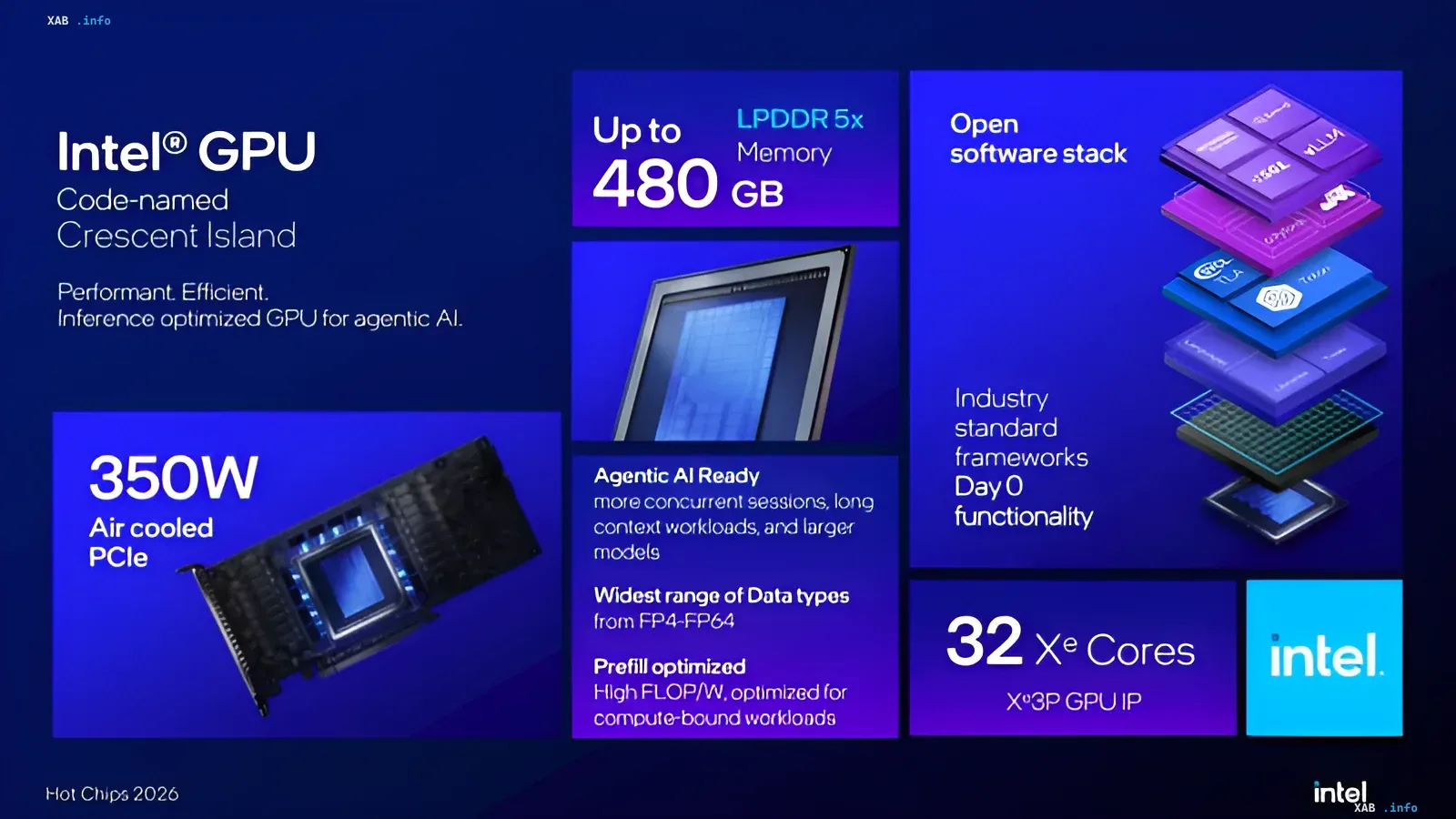
At the Hot Chips 2026 conference, held in August 2026, Intel presented the detailed architecture of its Crescent Island accelerator — a specialized GPU for AI inference workloads in data centers. The company revealed the chip's compute fabric for the first time: the accelerator features 32 Xe3P cores and 256 XMX matrix engines, and supports up to 480 GB of LPDDR5X memory. According to Intel's positioning, Crescent Island is a "performant and efficient GPU optimized for agentic AI," underscoring its focus on serving large numbers of autonomous AI agents rather than on neural network training.
Architecture: Four Compute Slices and the Drop of 3D Graphics
The compute fabric of Crescent Island is organized into four Compute Slice blocks, each combining eight Xe cores. In total, the GPU is equipped with 32 Xe3P-architecture cores, 256 vector engines, and 256 XMX matrix engines responsible for accelerating the matrix operations that underpin neural network workloads. Each Xe core is outfitted with 512 KB of unified L1 cache and SLM local memory, yielding a combined 16 MB at the first level. Additionally, the chip provides 32 MB of shared second-level cache. The Xe3P architecture is a specialized evolution of Xe3, emphasizing performance and energy efficiency under compute workloads: Intel deliberately dropped the blocks required for traditional 3D graphics processing, redirecting the freed transistor budget toward compute resources. The accelerator supports a wide range of data formats — from FP4, targeted at AI inference, to FP64, required for high-precision scientific computing.
Memory: A Bet on LPDDR5X Instead of HBM
One of the most discussed features of Crescent Island is its memory subsystem. Instead of the expensive HBM used by modern Nvidia and AMD accelerators, Intel chose LPDDR5X. Intel's own reference card will be equipped with 160 GB of memory, while the company's partners will be able to build accelerators with up to 480 GB. This approach delivers lower bandwidth than HBM, but allows a substantially larger memory capacity at moderate cost and power consumption. The large memory capacity is intended to enable entire large language models to reside on a single accelerator, to serve longer context, and to handle requests from a greater number of AI agents concurrently — key requirements for the "agentic" scenarios Intel is betting on.
Positioning: Inference, Not Training
Crescent Island is not designed to compete with the most powerful neural network training accelerators, but primarily to run already-trained models economically. Intel places particular emphasis on the cost of token generation and on the ability to install new accelerators into existing server racks without moving to liquid cooling. The reference PCIe card for Crescent Island has a 350 W power envelope and is designed for standard air cooling. The presentation slide also highlights that the architecture is optimized for the prefill phase (High FLOP/W, compute-bound workloads), which is characteristic of inference workloads with long context.
Software and Ecosystem
Intel touts an "open software stack" and "Day 0" support for industry-standard frameworks. The software visualization shown on the Hot Chips 2026 slide displays layers including the Intel AI Library, OneAPI, and other components, as well as integration with popular ML frameworks. Agentic AI readiness is emphasized: support for more concurrent sessions, long-context workloads, and large models is presented as a key architectural property of the platform.
Timeline and Shipping Dates
Crescent Island was first announced by Intel in the fall of 2025 with a base 160 GB LPDDR5X configuration. In the spring of 2026, the company expanded the platform specification, allowing partners to build versions with up to 480 GB of memory. The first accelerator samples are expected to reach customers in the second half of 2026. Specific performance figures in FLOPS or tokens per second, as well as exact mass-production shipping dates, were not disclosed by Intel at the time of the Hot Chips 2026 presentation.